Comments to SITO enterprise pattern (see the updated version of it at http://improving-bpm-systems.blogspot.com/2011/10/enterprise-pattern-structuring-it.html ) were that it is too classic. Sure, structuring is the first step to establish the balance between functions and projects.
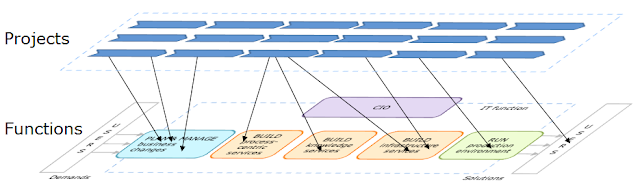
Next step is how to preserve, enrich and re-use the technical/business knowledge and experience gained in each project. A possible way is to create competence forums which are oriented to deliver business-generic services (or "needs" as they mentioned in http://improving-bpm-systems.blogspot.com/2011/09/writing-it-strategy.html ). Usually, such services are based on several IT-generic services which are mastered in different IT functions.

How those competence forums to be managed to avoid over complication and conflicts of responsibilities? Competence forum is led by the CIO with the help from an informal leader from the participants. For example, the CIO chaired a few initial meetings and then delegates the routine work to the informal leader.
Next step, the IT governance, was already covered in http://improving-bpm-systems.blogspot.com/2011/01/relationships-between-ea-and-pmo.html . Just a small addition to that post:
Thanks,
AS

Next step is how to preserve, enrich and re-use the technical/business knowledge and experience gained in each project. A possible way is to create competence forums which are oriented to deliver business-generic services (or "needs" as they mentioned in http://improving-bpm-systems.blogspot.com/2011/09/writing-it-strategy.html ). Usually, such services are based on several IT-generic services which are mastered in different IT functions.

How those competence forums to be managed to avoid over complication and conflicts of responsibilities? Competence forum is led by the CIO with the help from an informal leader from the participants. For example, the CIO chaired a few initial meetings and then delegates the routine work to the informal leader.
Next step, the IT governance, was already covered in http://improving-bpm-systems.blogspot.com/2011/01/relationships-between-ea-and-pmo.html . Just a small addition to that post:
- EA (or EITA) defines/monitors WHAT should be done (technical coordination of the enterprise IT environment).
- PMO defines/monitors HOW it should be done (administrative coordination of changes in the enterprise IT environment).
Thanks,
AS


 Posts
Posts

