2011-12-18

Enterprise pattern: #Cloud-Ready Estimation and Evaluation Procedure (CREEP)

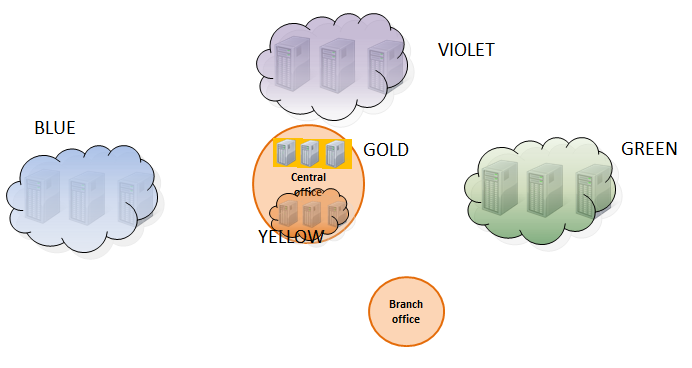
The aim of this post is to consider a systematic procedure for estimation and evaluation of cloudability of an IT service – what type of cloud (GOLD, YELLOW, GREEN, BLUE, VIOLET) is acceptable for a particular IT service and for what cost. Quick reminder re the zone types (from http://improving-bpm-systems.blogspot.com/2011/07/1-relationships-between-enterprise.html ):
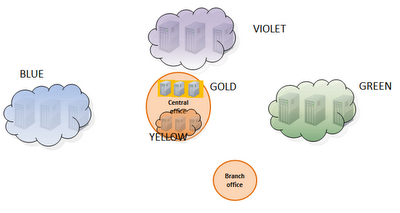
  • classic within enterprise computing centre – zone type GOLD; 
  • within enterprise private cloud – zone type ORANGE; 
  • outside enterprise and enterprise-managed private cloud – zone type GREEN; 
  • outside enterprise and service-provider-managed private cloud – zone type BLUE; 
  • public cloud (outside enterprise and service-provider-managed by definition) – zone type VIOLET. 
The evaluation consists of two parts:
1. ranking of an IT service by several characteristics,


2. decision table for acceptability of cloud solution (actually, what ZONEs are acceptable for this IT service). 
Note: “maybe” means that further investigation is necessary;
Note: more than one column for GREEN, BLUE, and VIOLET can be possible if you work with several providers

Example: SharePoint Extranet


Ranking applied


Decision table applied
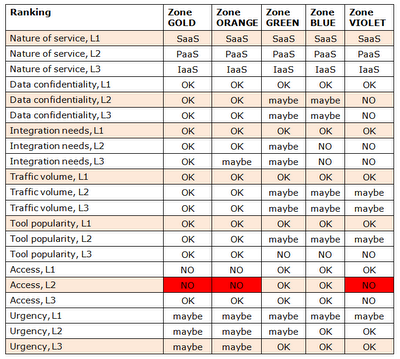


Rules for the recommendation :
  1. If at least one “NO” then “NO”
  2. If no “OK” and some “maybe” and “IaaS/PaaS/SaaS” then “maybe” + “IaaS/PaaS/SaaS”
  3. If some “OK” and some “maybe” and “IaaS/PaaS/SaaS” then “OK” + “IaaS/PaaS/SaaS”

Note: CAPEX and OPEX are functions of a service and a zone type.

Resume: 3 zones are not recommended, 2 accepted as SaaS:
1st preference SaaS in BLUE zone; CAPEX = ...  OPEX =... Lead time=....
2nd preference SaaS in GREEN zone; CAPEX =.. OPEX =... Lead time=...

Thanks,
AS

2011-10-15

Enterprise pattern: Structuring IT Organisation (SITO)

How to decompose an IT organisation into smaller units?

Approach

  1. Collect major IT-related functions (approx. 30-50) to be carried out at an IT organisation; potential sources COBIT, ITIL, PMBOK, PRINCE2, HERMES, etc. 
  2. Draw a matrix of mutual relationships between those functions or group of functions (about 10) 
  3. The relationships may be like “synergy” (functions to be carried-out rather together) 
  4. The relationship may be like “prohibition” (functions to be carried-out by different units because of SoD principle, good practices, etc.) 
  5. Each particular relationship has to be justified 
  6. Find clusters in that matrix 

Example of  the relationship matrix:

Potential functional groups

  • GOVERN – administrative coordination as the whole -- set and maintain internal policies, controls and processes
  • ARCHitect – technical coordination – define structural changes (of core capabilities and services) in response to business and technologies changes
  •  Make SAFE (added to be conceptually complete) – define policies concerning the confidentiality, integrity and availability of information services 
  • Supervise building of core services and capabilities – project management (PM) Supervise operating of core services and capabilities – operations monitoring (OM) 
  • BUILD core capabilities and services: application services, information services and infrastructure services 
  • OPERate core capabilities and services – integration, pilotage and service desk
  • EVALuate (as an independent control) capabilities 
  • INTERNal support capabilities 

Define YOUR rules for decomposition

Depending on your current needs and concerns, define two group of rules.

Prohibition rules:
  • P1 Separate doing and supervising/controlling – SoD 
  • P2 Separate architecture/design and implementation – SoD, specialisation and quality at entry 
  • P3 Separate implementation and operation – SoD, specialisation and quality at entry 
  • P4 Policy vs applying it – legislation vs executive separation 
  • P5 Specialisation

Synergy rules:
  • S1 Close work (e.g. there is a primary / single client for services of that function) 
  • S2 Architecture role to guide (an architect is a person who translates a customer’s requirements into a viable plan and guides others in its execution) 
  • S3 Synergy between technical and administrative activities (how you do something may be more important what you do)

Example of relationship matrix


Arrangement of functions into smaller units (divisions)

BUILD-related functions are decomposed into three (process-centric, knowledge and infrastructure) due to specialisation.


So, the structure should be as shown below.


Thanks,
AS

2011-10-09

EA view on Enterprise Risk Management (ERM) platform

In many cases, it is impossible to find a single ERM product which spans all business areas to be covers by ERM. So, it requires building an internal ERM platform on top of which different ERM-related applications will be built (following the PEAS enterprise pattern – see http://improving-bpm-systems.blogspot.com/2011/04/enterprise-patterns-peas.html ).

Business architecture view

Risk must be carefully monitored (through data collection), evaluated and acted upon. This means (see also the illustration below):
  1. Enterprise business functions should be enriched to generate the risk-related data.
  2. Those risk-related data need to be collected at the enterprise data warehouse together with other business data.
  3. Some business processes need to be updated to embed risk-related activities.
  4. A set of risk-related rules, logic and risk-related knowledge should be able to use the risk-related and other business data to detect acceptable limits of risk as well as interdependencies and correlations between different risks.
  5. Some business processes for risk mitigation maybe automatically activated.
  6. A lot of risk-related indicators, alerts should be available in the form of dashboards and reports available for different staff members.
  7. Staff members should be able to initiate business processes based on the observed risk-related information.


Business-generic capabilities involved

The following business-generic capabilities are involved in the ERM platform:
  • Management by processes
  • Efficient data gathering channels
  • Single version of truth for data
  • Ingesting (into the data warehouse) of external information
  • Efficient dissemination channels
  • Effortless collaboration within groups / communities of practices
  • Formalized business logic

Supremacy of management by processes

Managing any work by processes is the key business capability with allows to address the risk-related issues in a proactive manner. The risk is strongly related to how the business processes are carried out. By understanding a process (i.e. through being able to simulate it) the business may predict how the risk is changing during the execution of that process. The explicit description of processes permits to add a few “check-points” within any process to examine its risk-related “health”.

Business processes act as a skeleton to which the enterprise adds risk management (as shown on the picture below) – each usual activity is enriched by risk-related monitoring and evaluation.

The risk evaluation may initiate some risk mitigation processes. The risk evaluation may be as complex as necessary, and it may include simulations (e.g. value at risk and stress testing), and the conduct of statistical and scenario analysis.

IT-generic capabilities involved

The following IT-generic capabilities are involved into the ERM platform:
  • Enterprise resource planning platform
  • Data analytic
  • Business process management platform
  • Business intelligence platform
  • Business rules management platform
  • Document management platform
  • Corporate portal

Thanks,
AS

2011-09-22

Writing IT strategy


The IT strategy development logic is the following:
Business strategy -> business architecture TO-BE -> application + information architectures TO-BE -> technical architecture TO-BE -> IT (or EA) AS-IS -> IT roadmap

Main topics in the IT strategy document are the following:
  1. Executive summary (½ page – summary for senior management, e.g. the Board members)
  2. Business context (½ page – WHY the major directions in the IT strategy have been taken)
    • Strategic directions for the IT as an enabler for the company’s mission and vision
    • Potentials of the IT as a strategic driver for the company’s business
  3. IT contribution to business success (1 page - HOW IT capabilities and plans will contribute value to the business or delta in business is reflected by the delta in IT)
  4. IT guiding principles (½ page – rationales to guide IT decision making)
  5. Assessment of the current state of the IT environment
  6. IT Roadmap (WHEN and WHAT to reinforce and build)
  7. Etc.

Item 3 is illustrated by the following image:


Ideally, such dependencies can be generated from business processes and applications (i.e. from your EA repository).

In the real situation this illustration may become rather complex, so some techniques for better understanding can be necessary. For example, the selection of a rectangular highlights all connected rectangulars and links, as shown below:


And the final advise: be careful with arrows - people may interpret them differently.

Thanks,
AS


2011-08-17

Relationship between #BPM and #SDLC and Software Engineering (SE)

In my experience, BPM and SE are very natural friends (with the help from SOA, EA and BA) which work well together within a proper architecture.

Some basics: Any complex system is a dynamic set of artefacts (or building blocks?), e.g. in case of a typical business system those artefacts are: processes, services, events, data structures, documents, rules, roles, activities, audit trails, KPIs. Artefacts are interconnected and interdependent. We have to anticipate potential changes: policies, priorities, compliance, technology, etc. Implementation of such changes necessitates the evolution of some artefacts and the relationships between them. It must be easy to modify all artefacts and relationships without causing any negative effects.

My main architectural principles for creating flexible systems:
  • All artefacts must be evolved to become digital, external, virtual and components of clouds
  • All artefacts must be versionable throughout their lifecycle
  • All relationships between these artefacts are modelled explicitly
  • All models are made to be executable
(See http://www.improving-bpm-systems.com/pubs/AS-AW08-keynote.pdf)

So, BPM (with the help from BA, see http://improving-bpm-systems.blogspot.com/2011/02/explaining-ea-business-architecture.html) can derive the artefacts. And SE is responsible for creating good services for all artefacts.

Then BPM, EA and SE have to work together to make explicit and executable models. The best example of executable models is executable business processes. Any business process is a relationship between many artefacts: who (roles) is doing what (business objects), when (business events), why (business rules), how (business activities or other processes) and with which results (KPIs). At the same time, such a process is an explicitly-defined coordination of services to create a particular result. So, there is a recursive relationship between services and processes:
  • all our processes are services,
  • some operations of a service can be implemented as a process,
  • a process includes services in its implementation.
This is the base of a modelling procedure (the core of the SE) whose purpose is to analyse a building block (processes or just activities – what is it supposed to do and should it be considered as a whole?) and to synthesize its implementation (how does it carry out its function and should it be considered as a composite?) as the explicit coordination of other building blocks (processes or just activities).

It is an iterative procedure – it can be applied until we only have left indivisible building blocks (i.e. activities). During modelling it is necessary to collect and refine the different artefacts. To avoid getting bogged down in detail it is useful to construct building blocks recursively, like Russian dolls.

Of course, owing to very nature of modelling as a creative problem-solving human activity, each person does it in his/her own way, and for the same subject two different people may produce two different models. The proposed modelling procedure can’t change this, but it does help to uncover the same artefacts.

Mode details are in my book http://www.improving-bpm-systems.com/book

Thanks,
AS

2011-07-30

E-Tunisia / e-consultations: solution architecture

General


 Continuation from the previous post - E-Tunisia / e-consultations: overview


Definition


E-consultations constitute interactive “tell-us-what-you-think” on-line services where ordinary citizens, civic actors, experts, and politicians purposively assemble to provide input, deliberate, inform, and influence policy and decision making.

Privacy considerations

  1. Only authorized person can actively contribute (i.e. add some text) in e-consultation services.
  2. The identity of the person may is hidden.
  3. The enrollment will include the identity verification.
  4. Further a person can hide his/her identity under an avatar.
  5. The correspondence between an avatar and the identity is secret, but may be disclosed in case of misbehavior. Example: Facebook.

Nomenclature of e-consultation services


Maybe this nomenclature is not full yet.


Question and answer discussion forums

It is a free form on-going thematic discussion initiated in a community of interests. Each contribution is named. A discussion may be closed (only within the community) or open for everyone (or even to the Internet). Examples: discussions in Linkedin.


On-line polls

A time-bounded questionnaire.


E-petitions or on-line testimonies

A person (or an association) initiates a formal demand to public services. Such a demand should start a process which should lead to a meaningful response. People, other than the initiator, can express their opinion (support or not) about the demand. Example: Reporting Damaged Roads and Paths https://www.contact.act.gov.au/app/answers/detail/a_id/22/~/reporting-damaged-roads-and-paths

E-panels

A time-bounded nominee-only group open discussion on issues of public interest.

Editorial consultations

A time-bounded multi-authoring of a document or a set of documents. There are several options about who can edit the text. A possible option is that many people can contribute to the content via comments and small (editorial) group can modify the text to reflect those comments.


Use of the e-government platform

E-consultation services are applications implemented on top of the e-government platform (see chapter 5). The latter provides different common services for facilitating the implementation of such application and keeping the same look and feel for better user’s experience. Each application is self-contained, developed in accordance with platform’s rules and may evolve without causing negative effects to others. Number of applications within the platform is not limited.


Enabling the public-private partnership

Systematic approach to very critical IT issues such as authorization, data security, access control, etc. clears a way for re-use of available data. It will be possible to estimate how the disclosure of some of those data will effect to the level of protection of remaining data.

Ability to open some data makes possible to employ private investments for improving some applications (it is considered that all applications are developed mainly by centralized capital investments).

Such investment attraction should be estimated for each application.

The big picture of e-government platform

E-consultation services are e-government services. The e-government (as one of its functions) provides (via ICT) to partners (citizens, enterprises, associations, etc.) the governmental services. To introduce the e-government without disturbances to existing governmental applications, it is proposed to position the e-government is a layer between the partners and the existing governmental applications (as shown in figure below).


The partners-facing part of the e-government is a collaborative extranet which is similar to popular social networking tools (Facebook, LinkedIn, etc.) and e-banking. Its main functionalities are the following:
  • secure repository for short messages, documents, and video;
  • dedicated (including role-based) information and functionality;
  • diverse services as small pluggable applications,
  • direct channel to the governmental business processes; and
  • unified view of central, regional and local governments.

The government-facing part of the e-government is the integration and coordination capabilities which are necessary to fulfill needs of partners.

Important that the whole e-government is separated from the existing governmental environment. This separation means operational and evolution independence.
The common functionality of the e-government platform is presented below.


Expected advantages:
  • Quick implementation
  • Easier maintenance
  • Explicit security
  • Uniformity for the users


Implementation principles

  • Keep the conceptual integrity.
  • Take into account socio-technical aspects, because how you do something is sometimes more important than what you do.
  • Unity the infrastructure and reach different mobile tools
  • Systematically use open source software
  • Provide security at the level of private banking
  • Ruthlessly validate the implementation by international experts and hacker groups and political parties
  • Develop agile and deploy step-by-step within the common architecture
  • Guaranty the total traceability and records management
  • Exchange by electronic documents

Infrastructure implications

To cover the population, it is necessary to establish a network of social computing centres. The latter may be located at local community premises (e.g. a public library, “hotel de ville”, etc.). Those centres may also provide wireless access points.

Possible next actions

  1. Validate of this architecture
  2. Organise wide consultations with all involved partners
  3. Solicit the feedback from international experts
  4. Launch the feasibility study

Thanks,
AS

2011-07-29

E-Tunisia / e-consultations: overview


Continuation from the previous post - E-government for Tunisia (E-Tunisia) : Help to move forwards

We, the people, are the government


E-consultations constitute interactive “tell-us-what-you-think” on-line services where ordinary citizens, civic actors, experts, and politicians purposively assemble to provide input, deliberate, inform, and influence policy and decision making. E-consultation is complimentary to existing practices.

E-consultations are also more formal and structured than discussions in the informal virtual public sphere. They tend to have a set duration, agenda, employ the use of moderators, with topics for discussion pre-defined by the host.

There are five common types of e-consultations:
  1. question and answer discussion forums
  2. on-line polls
  3. e-petitions or on-line testimonies
  4. e-panels
  5. editorial consultations
Usual challenges:
  1. population coverage
  2. integrity
  3. visibility
  4. transparency and disclosure obligations are vital (with confidentiality only applying on matters of a personal nature)
  5. usual distrust towards new electronic applications
  6. balance of central and local power
Local challenges:
  1. 10 million people
  2. huge diversity in education and income
  3. political instability
  4. lack of a comprehensive Internet infrastructure
Local opportunities:
  1. the top African country in the UN e-government study 2010
  2. high level of the IT local resources

Solution architecture will be another post .

Thanks,
AS