<discussion ref="http://www.linkedin.com/groupAnswers?viewQuestionAndAnswers=&gid=1062077&discussionID=3125251&sik=1274510902551&trk=ug_qa_q&goback=.ana_1062077_1274510902551_5_1" />
A good pitch needs a good context. In the case of BPM, the context should cover: 1) concrete people, 2) their concrete problem(s) to be solved 3) your good knowledge how to use BPM as a powerful tool and 4) relevant stories.
Particular complexity of BPM is that it should be explained to different people (within an organization) in their language, in different ways, and all these explanations should not contradict each other.
Particular beauty of BPM is that it can be used for solving problems which are not usually associated with BPM. For example, a company wanted to select a common electronic publishing tool instead of 30 different tools but each from 30 departments claimed that their use of their tool is unique and it is impossible to select one common tool. As a proof each department showed their publishing processes. We remodeled all these processes with the same modeling procedure and demonstrated that all these processes use a limited set of basic services (but sometimes in different orders). As the result, we have selected a common tool which provides those basic services and can assemble them into different publishing processes.
Thanks,
AS
Showing posts with label example. Show all posts
Showing posts with label example. Show all posts
2010-05-22


2009-09-25
Practical process patterns: BMI
Block Multiple Instances (BMI) pattern allows several process instances wait for an event (a variation of the CPP pattern from my book).
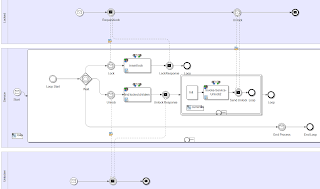
Pool "locked" is an example how to put itself into a waiting list.
Richard Vigniel (a colleague of mine) has implemented this pattern in Intalio 6.0.1 (executable example is downlodable from http://www.improving-bpm-systems.com/misc/lockservice.zip).
Thanks,
AS

Pool "locked" is an example how to put itself into a waiting list.
Richard Vigniel (a colleague of mine) has implemented this pattern in Intalio 6.0.1 (executable example is downlodable from http://www.improving-bpm-systems.com/misc/lockservice.zip).
Thanks,
AS
Subscribe to:
Posts (Atom)


 Posts

