2010-01-14

Blog: Is BPM a Dirty Word?

<discussion ref="http://www.theprocessninja.com/process/2010/01/is-bpm-a-dirty-word.html" />

Of course, BPM is a dirty word in its current (mis-)use - because BPM is a vendor-driven market - "The most important success factor of a BPM project is a selection of the right BPM tool".

Agreeing with the post and previous comments - BPM should be returned to business and must become a customer-driven market. I think, it may be done in the following sequence:
  1. BPM is discipline to use processes to manage the business (a reference BPM model is very important)
  2. BPM is a system (hence architecture is very important) to manage the full lifecycle of processes within an enterprise
  3. A BPM tool should be selected on the basis of that architecture.

Thanks,
AS

2010-01-11

Linkedin: Which of the two should be key metrics for measuring successful BPM?

<discussion ref="http://www.linkedin.com/groupAnswers?viewQuestionAndAnswers=&gid=1847467&discussionID=10601888&sik=1263196787644&trk=ug_qa_q&goback=.ana_1847467_1263196787644_3_1" />

In favor of a more generic measure. BPM as a tool for improving enterprise business performance is capable to carry out different combinations of different types (operational, tactical, strategic, competitivity) of improvements as required in different moments of time. So, a set of KPIs may be different at each particular improvement. Thus the key metric is how easy to apply/use BPM to improve the enterprise business performance.

Sure, that your BPM system should be very flexible and this flexibility should be architected.

Thanks,
AS

2010-01-10

Linkedin: Brainstorming on Adaptability / Flexibility

<discussion ref="http://www.linkedin.com/groupAnswers?viewQuestionAndAnswers=&gid=84758&discussionID=11789589&sik=1263141957825&trk=ug_qa_q&goback=.ana_84758_1263141957825_3_1" />


My area is to improve not general, but IS/IT capacity of change, because the latter is the main blocking factor in many organizations. Usually, we do some specific initiatives first and then spread and generalize the experience. I use several techniques:
  1. Show the slide 4 from http://www.slideshare.net/samarin/creating-synergy-between-bpm-and-ea-in-an-egovernment-environment to indicate importance of flexibility.
  2. Coach the business how to request and test flexibility of different IT products (instead of just compliance to the specs), e.g. a vendor of BPM suite should be asked to implement a simple process and to carry out some changes during the live presentation.
  3. Prepare prototypes which demonstrate flexibility.
  4. Rescue “rotten” projects.

A recent example – a tender for an MIS for a governmental agency.
  • High level of flexibility explicitly required
  • Budget 4,5 MCHF
  • About 10 offers
Some contenders:
  • Classic development – 17 MCHF
  • ERP hidden under workflow – 4 MCHF
  • BPM-based – 2,5 MCHF
The latter has demonstrated a simple prototype and that helped to win the tender. Of course, to calm down the internal IT department, the winner has to do an extra “feasibility” step -- quickly demonstrate a very advanced prototype, which works at the client’s IT environment.

Thanks,
AS


More details are in my new book “Improving enterprise business process management systems” www.samarin.biz/book

2010-01-09

Linkedin: SOA or not?

<discussion ref="http://www.linkedin.com/groupAnswers?viewQuestionAndAnswers=&gid=36604&discussionID=11868557&sik=1263034934834&trk=ug_qa_q&goback=.ana_36604_1263034934834_3_1" />

I agree that just defining all processes and then “converting” activities into services is not a good idea (e.g. because of potential absence of a good structure as mention in that anti-pattern). Also, I noticed that, just defining all services and “pushing” processes into them is a challenge.

I consider the following relationships between services and processes:
• all our processes are services,
• some operations of a service can be implemented as a process,
• a process includes services in its implementation.
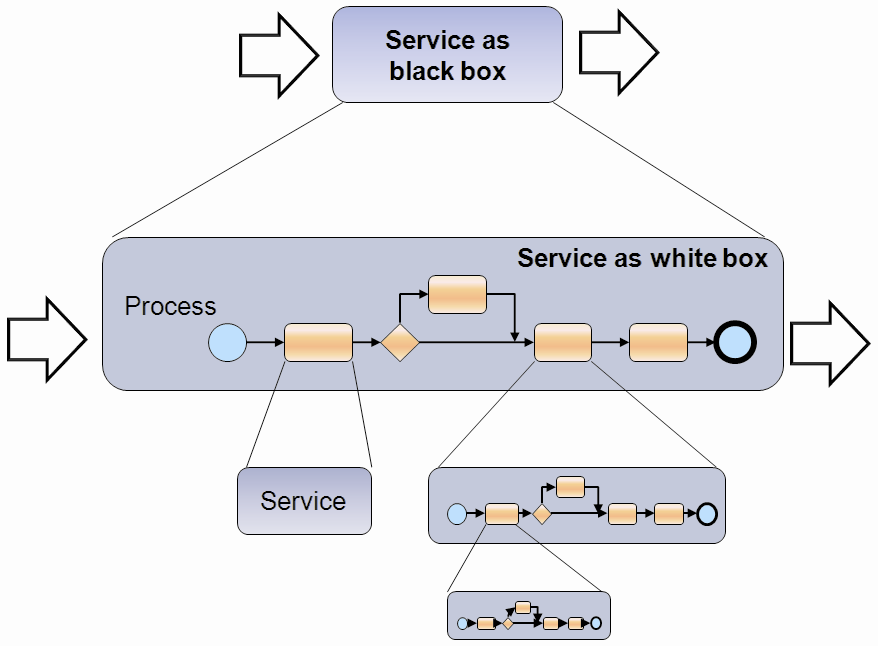


To find out these relationships at a particular enterprise, I recommend a 4-phase modelling procedure
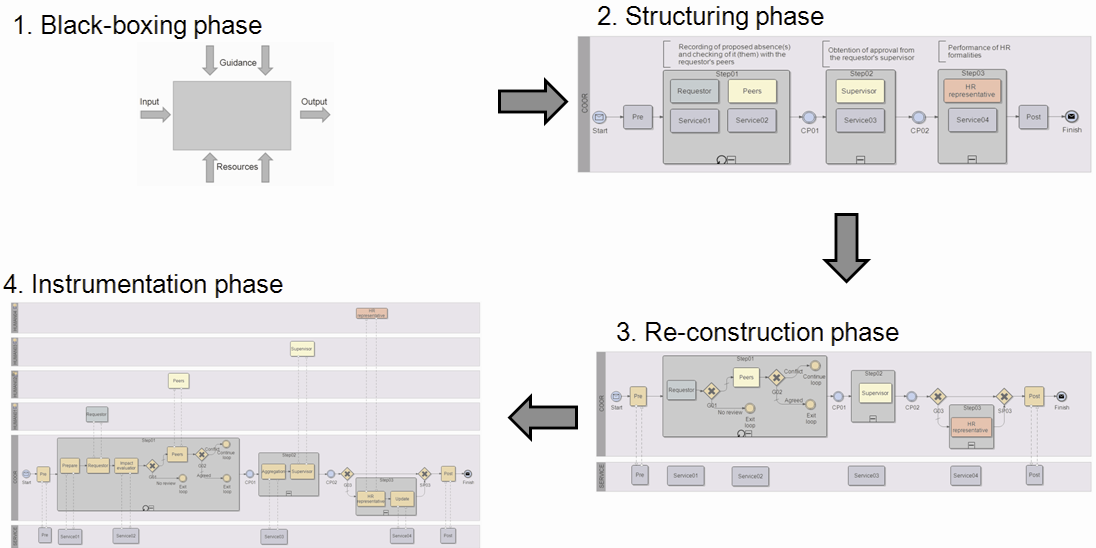
which incrementally structuring processes and services, as well as avoids diagrams like


“Services are not supposed to make assumptions about the context in which they are invoked. Driving service identification from the process risks making the service useful in only that process.”

Sure, no assumptions. Services are designed to work in context – the latter defines functional and non-functional characteristics of a service. The usage of the same modelling procedure increases probability that two different people will find similar services in the same context. Also, the high level of flexibility is necessary to quickly refactor slightly different services into one reusable service.

Thanks,
AS

More details are in my new book “Improving enterprise business process management systems” www.samarin.biz/book

2010-01-08

Linkedin: How does architecture ensure system flexibility?

<discussion ref="http://www.linkedin.com/groupAnswers?viewQuestionAndAnswers=&gid=1523&discussionID=10617743&sik=1262950490126&trk=ug_qa_q&goback=.ana_1523_1262950490126_3_1" />

Any complex system is a dynamic set of artefacts (or building blocks), e.g. in case of a BPM system those artefacts are: processes, services, events, data structures, documents, rules, roles, activities, audit trails, KPIs.

Artefacts are interconnected and interdependent. We have to anticipate potential changes: policies, priorities, compliance, technology, etc. Implementation of such changes necessitates the evolution of some artefacts and the relationships between them. It must be easy to modify all artefacts and relationships without causing any negative effects.

My main architectural principles for creating flexible systems:
- All artefacts must be evolved to become digital, external, virtual and components of clouds
- All artefacts must be versionable throughout their lifecycle
- All relationships between these artefacts are modelled explicitly
- All models are made to be executable

See http://www.improving-bpm-systems.com/pubs/AS-AW08-keynote.pdf

Thanks,
AS

More details are in my new book “Improving enterprise business process management systems” www.samarin.biz/book

2010-01-05

Be explicit with BPM as a management discipline

Business Process Management (BPM) as a management discipline means "using processes to manage business" ("stolen" from Connie Moore's twit).

French version should be "Gestion par processus", but not "Gestion de processus métier".

Russian version is "Управление предприятием на основе процессов".

Of course, "management of business processes" is also necessary.

Thanks,
AS

2009-12-11

BPM for CMMI

The aim of this paper is to match BPM (see annex A for some BPM basics) and the process improvement approach used in the CMMI-SVC v1.2 [1].

The summary is the following:
1. understanding of BPM discipline is very beneficial for improving your CMMI processes
2. staring from “defined processes” (capability level 3) it is necessary to use BPM suite software
3. moving to higher levels requires the serious thinking about architecting of your BPM system to support your CMMI processes

Thanks,
AS