Showing posts with label coordination. Show all posts

2015-04-20

Architecting #cloud-friendly application architecture #apparch (inspired by #microservices)

1 Introduction


This blogpost extends the blogpost “Architecting application architecture #apparch (inspired by #microservices)” http://improving-bpm-systems.blogspot.ch/2014/12/architecting-application-architecture.html to “cloud-friendly application architecture”. You may jump to chapter 8 to see a demo of it.

This cloud-friendly application architecture opens the way to synergy between #BPM, #SOA, #cloud, #microservices, #IoT, #digital and #security.

2 Clarification of some terminology


2.1 Process

Many articles about microservices mentioned “process”. I believe they mean “computing process” (e.g. an instance of JVM) which should not be confused with “business process”.

2.2 Orchestration

Another confusing term is “orchestration”. In some articles, it means “container orchestration layer” which allows one to specify how the micro-services are handled in fault tolerant and in scaling up and scaling down (see http://cloudramblings.me/2015/03/20/microservices-martin-fowler-netscape-componentized-composable-platforms-and-soa-service-oriented-architecture ).

See also http://www.slideshare.net/adriancockcroft/dockercon-state-of-the-art-in-microservices slide 70 “Orchestration for Applications”

O’Reilly book “Migrating to Cloud-Native Application Architectures” http://pivotal.io/platform-as-a-service/migrating-to-cloud-native-application-architectures-ebook says “The ESB becomes the owner of all routing, transformation, policy, security, and other decisions governing the interaction between services. We call this orchestration, analogous to the conductor who determines the course of the music performed by an orchestra during its performance. ESBs and orchestration make for very simple and pleasing architecture diagrams, but their simplicity is deceiving. Often hiding within the ESB is a tangled web of complexity.” I think, this is a wrong analogy. The conductor delivers only one symphony at a time. ESB delivers many symphonies at the same time. Not surprising that it such “centralised orchestration” is difficult.

In other articles, it means one of two BPMN ways to compose business processes – orchestration as a strong coordination and choreography as weak coordination. This orchestration is a domain bounded because it is carried out in the scope of a particular business process.

3  Commenting some posts about microservices


From http://intellyx.com/2015/03/11/microservices-avoiding-dumb-pipes/ “Rather, we simply have a new way of thinking about “smart” pipes – microservice integration that is architected following web scale, cloud-centric principles.”

Good point although I think being “cloud-friendly” is better than “cloud-centric” as the hybrid environment is very attractive right now.

From http://www.computerweekly.com/feature/Microservices-How-to-prepare-next-generation-cloud-applications “Each microservice is an independent, autonomous process with no dependency on other microservices. It does not even know or acknowledge the existence of other microservices.

Microservices communicate with each other through language and platform-agnostic application programming interfaces (APIs). These APIs are typically exposed as Rest endpoints or can be invoked via lightweight messaging protocols such as RabbitMQ. They are loosely coupled with each other avoiding synchronous and blocking-calls whenever possible.”

The first of these two paragraphs says that each microservice is “independent” from other microservices and the second paragraph says “microservices communicate with each other” thus there is some dependency.

Certainly, microservices are interdependent by design and operationally-independent. It seems that microservices may refer to each other indirectly via a “naming service” (some kind of URI to URL mapper or like in CORBA). Therefore, a microservice may employ other microservices to complete its work. In extreme, a microservice may be an assembly of microservices. Article http://microxchg.io/2015/slides/02_01_DomainServiceAggregators.pdf provides an example of data aggregation with a business domain.

From http://www.ben-morris.com/how-big-is-a-microservice/ ‘Perhaps “micro” is a misleading prefix here. These are not necessarily “small” as in “little”.’

Yes, size in LOC does not matter. There is only one limit – SRP. Interesting, that no limitations on “size” of this single responsibility. Thus a microservice with a greater and single responsibility may be assembled from microservices with lesser and single responsibilities.

From https://genehughson.wordpress.com/2015/02/06/wait-did-i-just-say-knuth-was-wrong/ “In the comments, it was suggested that granularity was irrelevant as multiple granular microservices could be composed to form a coarser-grained microservice that would provide a more appropriate level of abstraction. My response was that while this is theoretically true, aggregating service calls in that manner risks issues due to network latency.”

In addition for my comments to that blogpost, I would like to add that designing microservices as distributed autonomous components (each with own computing process) is forcing to consider (up-front and not as refactoring) a proper error-recovery which is much more difficult than the error-handling when components are in the same computing process.

From http://avirosenthal.blogspot.co.il/2015/04/micro-services-new-soa-style.html “How could a [Business] Capacity will be related to a Fine Grained entity such as Micro Service?”

In general, a business capability is a cohesive set of processes (or cluster of processes in accordance with http://improving-bpm-systems.blogspot.ch/2014/03/enterprise-as-system-of-processes.html ). Those processes are implemented as assemblies of microservices. Some of those microservices are unique for a particular process and for a particular cluster; others are shared between clusters.

From https://www.voxxed.com/blog/2015/01/good-microservices-architectures-death-enterprise-service-bus-part-one/ “Microservices and their granularity are ideal for the development and maintenance of the service. But that does push complexity more towards the app itself. A complexity that those apps cannot manage as they are often executed on platform with constrained resources (battery, network, CPU). Combining services in a higher level logic to serve the purpose of apps or business processes proves to be faster to develop and easier to maintain.”

Yes, assembling of microservices is the way to reduce complexity.

From http://martinfowler.com/articles/microservices.html “In short, the microservice architectural style is an approach to developing a single application as a suite of small services.”

If application as a unit of deployment (even decomposed into a few tiers) is no more the physical boundary then boundaries becomes logical and they are coming from the business – business functions, business services and business capabilities. Note they are actually just different viewpoints – see “Common understanding of #bizarch (business architecture) and #BPM” http://improving-bpm-systems.blogspot.ch/2015/01/common-understanding-of-bizarch.html . Less IT applications and more business-process-centric solutions.

From http://nealford.com/memeagora/2015/03/30/architecture_is_abstract_until_operationalized.html “Continuous Delivery and the DevOps movement illustrated the pitfalls of ignoring the effort required to implement an architecture and keep it current. There is nothing wrong with modeling architecture and capturing those efforts, but the implementation is only the first step. Architecture is abstract until operationalized. In other words, you can’t really judge the long-term viability of any architecture until you’ve not only implemented it but also upgraded it. And perhaps even enabled it to withstand unusual occurrences.”

Correct, but slightly simplified observations – actually, 3 (three) major upgrades are necessary to demonstrate that architecture is good. Rationale: it is recommend leaving a solution team before the 3th major upgrade of this solution.

From http://www.infoq.com/articles/service-oriented-architecture-and-legacy-systems “Integration suites offer a complete stack that not only gives ESB capabilities but also more business-specific tools such as BPM (business process management), business activity monitoring, master data management, and a repository.”

Sorry, but ESB is not the centre of the universe if the business position is taken http://improving-bpm-systems.blogspot.ch/2014/08/bpm-for-software-architects-from.html .


4 Forces

4.1 Containers enables the free movement of microservices

As microservices are not confined any more by the physical boundaries of application, they can freely move among on-premises environments, private and public clouds, intellectual “things” and even mobile devices. See “We’re finally headed towards autonomous, self-migrating containers for cloud-application automation” http://research.gigaom.com/2014/12/are-we-moving-to-autonomous-self-migrating-containers-for-cloud-application-automation-i-think-so/

As microservices become place-independent, it is necessary to have a good “naming service” (as we had in CORBA) to allow mapping of microservice’s URI to new URL. Such “naming services” is also known as discovery services.

The most popular container is www.docker.com. From http://www.infoq.com/articles/microservices-revolution “Docker’s appeal is twofold: it’s fast and it’s portable” and “Docker containers can start, and stop, in hundreds of milliseconds.” 

4.2 Microservices vs API

At present, there is no synergy between microservices and API as illustrated by the following quotes:
Considering that “IT application” as a physical boundary is disappearing with microservices and integration between “IT applications” often follows the span of business processes ( http://improving-bpm-systems.blogspot.ch/2013/06/enterprise-patterns-eclipse.html ) then microservices and API must “fuse”.

From http://cloudramblings.me/2015/03/20/microservices-martin-fowler-netscape-componentized-composable-platforms-and-soa-service-oriented-architecture/ “Part of the problem with API management and micro-services or with the mediation / message broker middleware technologies is that these can impose a software layer that is burdensome on the micro-services architecture... Let us say an approach to implementing micro-services would be to put them into a traditional API Management service as offered by a number of vendors. There would indeed be an overhead introduced because the API Layers impose a stiff penalty of authentication, authorization, then load balancing before a message can be delivered. What is needed is a lightweight version of API Management for some trusted services behind a firewall that are low risk and high performance.”

And from http://cloudramblings.me/2015/03/20/microservices-martin-fowler-netscape-componentized-composable-platforms-and-soa-service-oriented-architecture/ “Micro-services however should still be implemented in an API Management framework and ESB’s, Message Brokers and other SOA architectural components still make sense in this micro-services world especially when augmented with a container composition tool. In fact these components should be used to make micro-services transparent and reusable.”

Agree about simplification of API management which should not repeat mistakes of ESB being over complicated. 

4.3 Potentials of microservices

Are microservices going to replace apps and potentially be executable in Things linked to Internet of Things ? From http://www.computerweekly.com/feature/Microservices-How-to-prepare-next-generation-cloud-applications “The evolution of the internet of things and machine-to-machine communication demands new ways of structuring the application modules. Each module should be responsible for one task participating in the larger workflow.” Also, http://iot.sys-con.com/node/3289475?utm_content=buffer97b76&utm_medium=social&utm_source=twitter.com&utm_campaign=buffer .

Microservices and mobile apps from http://www.feedhenry.com/microservices-for-mobile/

Microservices and digital from https://www.linkedin.com/pulse/microservices-role-digital-business-architect-mike-clark and from http://forms2.tibco.com/rs/tibcoinfra/images/WP-microservices%20part1-web.pdf

Potentially better resilience from http://www.slideshare.net/ufried/patterns-of-resilience ?

Are microservices the next big thing from https://genehughson.wordpress.com/2015/04/09/are-microservices-the-next-big-thing/ . 

4.4 Concerns about microservices

From http://research.gigaom.com/2014/12/are-we-moving-to-autonomous-self-migrating-containers-for-cloud-application-automation-i-think-so/ “Using containers is not a new procedure: They certainly predate Docker. However, auto-provisioning and auto-migration are concepts that were often pushed but very remained elusive in practice.”

How does eventual consistency relate to SLA? Is eventual consistency applicable to all sectors?

Performance in https://genehughson.wordpress.com/2015/02/06/wait-did-i-just-say-knuth-was-wrong/

Misuse of technology from http://blog.christianposta.com/microservices/youre-not-going-to-do-microservices/

Challenges from https://www.voxxed.com/blog/2015/01/good-microservices-architectures-death-enterprise-service-bus-part-one/

A long list from http://highscalability.com/blog/2014/4/8/microservices-not-a-free-lunch.html “Significant Operations Overhead” “Substantial DevOps Skills Required” “Implicit Interfaces”, “Duplication Of Effort”, “Distributed System Complexity”, “Asynchronicity Is Difficult!”, “Testability Challenges”.

From http://blogs.gartner.com/gary-olliffe/2015/01/30/microservices-guts-on-the-outside/ ‘However, “there is a price to pay for microservices,” cautions Thomas. “You are increasing the complexity of the application system by having a lot more moving parts and a lot more interdependencies.”’

Various system-design related concerns from http://particular.net/blog/microservices-future-or-empty-hype .

A longer list on slide 34 from http://www.slideshare.net/myfear/eisele-architecting-largeenterpriseprojects-46546852 .

A collection of scaring factors from http://www.infoq.com/research/adopting-microservice-architecture?utm_source=infoqresearch&utm_campaign=rr-content .

And a few future problems from http://www.thoughtworks.com/talks/software-development-21st-century-xconf-europe-2014 .


5 Characteristics of cloud-scale applications

From http://devops.com/blogs/containers-designed-antiquated-application-architecture/ “Cloud-scale applications by nature are stateless with any application state being managed by cache or database services. The compute unit of measure is the process not the CPU, which enables greater scalability. .... They scale across network architectures easily allowing businesses to run in private data centers and leverage cloud for excess capacity when needed.”

From http://thenewstack.io/best-practices-for-developing-cloud-native-applications-and-microservice-architectures “Be micro”, “Be explicit”, “Be stateless”, “Be temporal”.

From http://12factor.net/backing-services “Twelve-factor processes are stateless and share-nothing. Any data that needs to persist must be stored in a stateful backing service, typically a database.” and “Treat backing services as attached resources”.

From http://www.infoq.com/articles/microservices-revolution “The point is that in the modern stateless application architecture, state is actually everywhere--and this state needs to be managed.”

A huge list from http://cloudramblings.me/2015/03/20/microservices-martin-fowler-netscape-componentized-composable-platforms-and-soa-service-oriented-architecture/ .

Slide 68 from http://www.slideshare.net/adriancockcroft/dockercon-state-of-the-art-in-microservices .


6 Becoming cloud-friendly

6.1 State management

Potential techniques for the state management:
  1. one persistency service (or backing service) for the state of the whole solution (even distributed solution) 
  2. predefined state which is created by embedding state into an individual containerized copy of the microservice (but the run-time knowledge about the context is mandatory) 
  3. idempotency 

6.2 Performance

Potential techniques for performance improvement (primarily the network latency):
  1. easy moving an individual containerized copy of the microservice between nodes (thus moving a microservice close to its consumer upto his/her mobile device) 
  2. on-demand creating an individual containerized copy of the microservice (but the run-time knowledge about the context is mandatory) 
  3. creating an individual containerized copy of the microservice for a particular consumer to diminish the security overhead (but the run-time knowledge about the context is mandatory) 

6.3 Lightweight security

  1. predefined state which is created by embedding security keys into an individual containerized copy of the microservice (but the run-time knowledge about the context is mandatory) thus achieving self-containment of PEPs 
  2. one-off execution (i.e. self-destruction) 
See also the blogpost “Enrich RBAC and ABAC with ProBAC” http://improving-bpm-systems.blogspot.ch/2015/01/enrich-rbac-and-abac-with-probac.html which explains how the run-time knowledge about the context can be provided to achieve “embedded” security.


7 Cloud-friendly architecture


Let us look at the post “Architecting application architecture #apparch (inspired by #microservices)” http://improving-bpm-systems.blogspot.ch/2014/12/architecting-application-architecture.html and extend the described in it architecture to being cloud-friendly. In that blogpost, I introduced Autonomous Component (AC) with a note that at present, it is not possible to claim that ACs are microservices or services.

This architecture implements business solutions (instead of IT applications because the boundaries of IT applications are not relevant any more) as a coordinated collection of autonomous components. Each AC is a unit of functionality (as SRP) which can be executed in its own computing process (thus a unit of deployment which can be deployed in a separate host somewhere). An AC may be an assembly of several ACs. In general, ACs are structurally interdependent, behaviorally (or operationally) independent and contractually dependent.

Below, several typical ACs are described from the “being cloud-friendly” viewpoint through the following characteristics:
  • state: “stateless”, “stateful” 
  • idempotency: “yes”, “no” 
  • instantiation: “availability-based”, “on-demand” (or “lazy loading”), “individual” 
  • place: “place-dependent”, “place-independent”, “multiple-place-independent” 
  • security: RBAC, ABAC, ProBAC, “embedded” 
Resource-access (RA) AC to carry out basic operations over data or documents which are stored in a single repository.
  • Cloud-friendly: stateful, place-dependent for updates, place-independent for reads, idempotent, availability-based-instantiation. 
  • Security techniques: RBAC, ABAC and ProBAC. 
  • Contracting ACs: No use of other ACs. 
  • Examples: access to a database, access to a document management repository. 
  • Note: Usually have an internal database. 
Resource-assembly-access (RAA) AC to carry out basic operations over a compound business entity (which comprises several resources).
  • Cloud-friendly: stateless, multiple-place-independent, idempotent, on-demand-instantiation. 
  • Security techniques: RBAC, ABAC, ProBAC and embedded. 
  • Contracting ACs: Use of some ACs, primarily, resource-access ACs. 
  • Example: virtual data layer, MDM. 
Persistence backing (PB) AC to keep a state or configuration.
  • Cloud-friendly: stateful, place-dependent, idempotent, availability-based-instantiation. 
  • Security techniques: ProBAC. 
  • Contracting ACs: No use of other ACs. 
  • Example: Database persistence layer. 
Utility (U) AC to transform or analyse data/documents.
  • Cloud-friendly: stateless, multiple-place-independent, individual-instantiation 
  • Security techniques: RBAC, ABAC, ProBAC and embedded. 
  • Contracting ACs: No use of other ACs. 
  • Note: May have its own configuration database. 
  • Example: Word-to-PDF converter. 
DSL-manager (DM) AC to manage DSL scripts.
  • Cloud-friendly: stateful, multiple-place-independent, availability-based-instantiation. 
  • Security techniques: RBAC. 
  • Contracting ACs: Use its own configuration persistence backing AC. 
  • Example: A business rules engine, process execution languages. 
DSL-processor (DP) AC to execute scripts in the DSL.
  • Cloud-friendly: stateless, multiple-place-independent, availability-based-instantiation. 
  • Security techniques: RBAC. 
  • Contracting ACs: Stateful DSL-processor has its own state persistence backing AC. 
  • Note: Business rules are considered be immutable thus its DSL-processes is stateless.
DSL-script (DS) AC to execute a particular DSL algorithm with some parameters.
  • Cloud-friendly: stateless or stateful, multiple-place-independent, individual-instantiation. 
  • Security techniques: RBAC, embedded. 
  • Contracting ACs: Use DSL-processor AC. 
  • Example: A particular rule for a particular business rules engine. 
Resource role-based mini-portal (RRBMP) AC to select data/documents and initiate an operation on them as a user-facing AC.
  • Cloud-friendly: stateless, multiple-place-independent, availability-based-instantiation 
  • Security techniques: RBAC. 
  • Contracting ACs: Use of some resource-access ACs and short-running ACs. 
  • Example: Web-client or Fat-client for a document management system. 
  • Note: Operation are usually short-running human and short-running automated ones. 
Functional role-based portal (FRBP) AC to select a function and execute it with some data/documents as a user-facing AC. It provides two types of operations: 1) static list of functions what this role may do and 2) dynamic list of activities what this role has to do. A function is a set of activities.
  • Cloud-friendly: stateless, multiple-place-independent, availability-based-instantiation. 
  • Security techniques: RBAC. 
  • Contracting ACs: Use some various ACs. 
  • Example: Intranet with some workflows. 
  • Note: There are two types of operations: 1An operation may be short-running human, short-running automated and long-running one. The latter is a coordination of short-running ones and other long-running ones. 
Human operation (HO) AC to interact with a human.
  • Cloud-friendly: stateless or stateful, multiple-place-independent, individual-instantiation. 
  • Security techniques: RBAC, embedded. 
  • Contracting ACs: May use some resource-access, resource-assembly-access and utility ACs. 
  • Example: Interactive form. 
  • Note: The state is kept in a solution-state persistence backing service. 
  • Note: Human operation AC may be short-running and long-running. 
Automated operation (AO) AC to transform some resources and/or solution-state data.
  • Cloud-friendly: stateless, idempotent, multiple-place-independent, individual-instantiation. 
  • Security techniques: RBAC, embedded. 
  • Contracting ACs: May use some resource-access, resource-assembly-access, utility and other ACs. 
  • Example: PublishDocument 
  • Note: May be implemented as a robot (scripts and their processor). 
  • Note: Automated operation AC may be short-running and long-running. 
Implicit coordination operation (ICO) AC to coordinate several human and automated operations AC.
  • Cloud-friendly: stateful, place-dependent, individual-instantiation. 
  • Security techniques: RBAC. 
  • Contracting ACs: Human and automated operations ACs. 
  • Example: A composite service. 
  • Note: Implicit coordination operation AC may be short-running and long-running. 
Explicit coordination operation (ECO) AC to coordinate several human and automated operations AC.
  • Cloud-friendly: stateful, idempotent, multiple-place-independent, individual-instantiation. 
  • Security techniques: RBAC, embedded. 
  • Contracting ACs: Human and automated operations ACs. 
  • Example: An assembly of other ACs. 
  • Note: Used human and automated operations ACs may be unique for this coordination operation AC. 
  • Note: It is implemented in a DSL; its DSL-processor AC has its own state persistence backing AC which acts as solution-state persistence backing AC. 
  • Note: Explicit coordination operation AC is mainly long-running. 
Legacy pseudo (LP) AC to access functionality of a legacy system.
  • Cloud-friendly: stateful, place-dependent, availability-based-instantiation. 
  • Security techniques: RBAC. 
  • Contracting ACs: Unknown. 
  • Example: ERP. 

8 Demo


The cloud-friendly application architecture is demonstrated on video below to show how various ACs implement a typical process-centric solution (this video is inspired by http://improving-bpm-systems.blogspot.ch/2014/12/bpm-for-soaesbapi-and-cloud-paas-and.html ). Obvious, presented scenario may handle several process-centric solutions and several copies of the same solution (a copy per user) simultaneously.

The scenario has the following stages:

a) The functional-role-based-portal AC offers to a user some functions to initiate (as a static list). Each of functions is an explicit-coordination-operation AC which comprises several human-operation ACs and automated-operation ACs. Human-operations ACs are to be executed by users and they are dynamically listed for each users.

b) All explicit-coordination-operation ACs are implemented as DSL-script. The DSL-manager AC provides a list of functions which are offered for users. The DSL-processor AC provides a list of activities which have to be executed by some users.

c) A user executes a function which is implemented as a DSL-script; the DSL-manager AC instantiates an individual copy of this explicit-coordination-operation AC via the DSL-processor AC. (Covered by markers 1-3.)

d) The first of two operations within this explicit-coordination-operation AC is the automated-operation AC which uses several other ACs; the explicit-coordination-operation AC instantiates an individual copy of this automated-operation AC and individual copies of two of ACs used by it (“Utility” and “Resource assembly access”). Then the automated-operation AC is executed (Covered by markers 4-6.)

e) The second of two operations within this explicit-coordination-operation AC is the human-operation AC; the explicit-coordination-operation AC instantiates an individual copy of this human-operation AC and an individual copy of the other AC used by it. (Covered by marker 7).

f) The human operation AC must be completed by a user and it informs the explicit-coordination-operation AC. (Covered by markers 8 and 9).

g) The explicit-coordination-operation AC terminates.


and its static view

9 Conclusion


The cloud-friendly application architecture follows the business domain boundaries, processes, entities, documents, roles and rules.

The cloud-friendly application architecture reduces complexity by adding a structure among ACs:
  • long-running functions (actually, business processes) 
  • short-running operations (actually activities or routines) 
  • assembly of resources (actually, business entities or business objects) 
  • resource (actually data and documents) 
The cloud-friendly application architecture reinforces the information security by dynamics security for resources and embedded security for ACs

In the cloud-friendly application architecture the majority of ACs are cloud-friendly thus solutions based on this architecture are scalable.

The cloud-friendly application architecture covers majority of cross-cutting concerns : event handling, error recovery, persistence (state management), concurrency, security, interactions, distributed transactions, logging, monitoring and testing.

Thanks,
AS


2014-12-24

Architecting application architecture #apparch (inspired by #microservices)

Base references


A few interesting recent discussions about microservices:
have inspired me to write this blogpost in addition to the several recent blogposts:
  1. “#BPM for software architects - from monolith applications to explicit and executable #coordination of #microservices architecture” http://improving-bpm-systems.blogspot.ch/2014/08/bpm-for-software-architects-from.html
  2. “#BPM for the #digital age – Shifting architecture focus from the thing to how the things change together” http://improving-bpm-systems.blogspot.ch/2014/08/bpm-for-digital-age-shifting.html
  3. “e-government reference model #GeGF2014 #egov #entarch #bpm #soa” http://improving-bpm-systems.blogspot.ch/2014/10/e-government-reference-model-gegf2014.html 
  4. “#BPM for #SOA+#ESB+#API and #cloud (#PaaS and #SaaS)” http://improving-bpm-systems.blogspot.ch/2014/12/bpm-for-soaesbapi-and-cloud-paas-and.html 
  5. "Ideas for #BPMshift – Delenda est “vendor-centric #BPM” – How to modernise a legacy ERP" http://improving-bpm-systems.blogspot.ch/2014/04/ideas-for-bpmshift-delenda-est-vendor_27.html

And other references:

Disclaimer


In this blogpost I try to stay at the conception level and avoid any implementation details (such as WS, REST, XML, API, HTTP, JSON, Web, common libraries, Java, etc.) – let us validate the concept first and then talk about implementation techniques.

At the same time, it is considered that there is no commonly-agreed definition of “microservice”. One of the reference definition of “service” is in http://www.infoq.com/articles/updated-soa-principles .

My definition of “service” is “explicitly-defined and operationally-independent unit of functionality”.

Application architecture current challenge


If, for a moment, we are not fussy with the terminology then we can accept a current challenge in the application development as it is defined by Jean-Jacques Dubray (as a comment to the first reference): the microservice architectural style ...is an approach to developing a single application as a suite of small services.

In other words, the question is how to implement an application as an organised collection of many autonomous components. Each Autonomous Component (AC) is (potentially) distributed (in-house or in-cloud) and thus it is a unit of deployment (otherwise it can be deployed in a separate host).

Note: At present, it is not possible to claim that ACs are microservices or services.

I think that this is a natural step in the evolution of the application architecture.

From monolith: one unit of deployment, one “in-process” (in techie’s meaning – in the same JVM), simple inter-component communication (again “in-process”) and simple error-handling (again thanks to “in-process”).

Then moved to client-server with two units of deployment (but not yet autonomous components): fat client (presentation and some biz logic) and the rest.

Then to three-tier with three almost ACs: thin client (presentation, better UX), business logic (calculations) and data access layer.

Now, with the recent popularity of mobile equipment, in addition to IT-centric decomposition (presentation, logic, data) into ACs, there is an opportunity for functional decomposition into ACs. So, each AC may have its own UI/presentation, logic, data and additional access channels, e.g. classic API. An example of functional decomposition is a portal – a data-centric portal for navigation over some data or a function-centric portal or a combination of them.

Meaning of “autonomous”


The word “autonomous”, being a keyword, requires an extra explanation. Some people associate it with “...Independent Scalability, Independent Lifecycle and Independent Data” but, let us look at the full life-cycle of AC.

In general, such a detailed life-cycle has the following phases:
  • Contextualise (or define future AC’s usage/expenses - WHY)
  • Plan (or schedule AC’s design, build and run - WHEN)
  • Design (or define AC’s characteristics - WHAT)
  • Build (or implement AC -HOW)
  • Bind (or linking)
  • Deploy (WHERE)
  • Run
  • Monitor (or meter of the usage of AC - WHO)
  • Measure (or evaluate the performance of AC – WITH WHAT RESULTS)
  • Un-deploy

Considering that each AC will participate in one or many assemblies for provisioning a “bigger” solution (or richer functionality), ACs are interdependent at their “creation” phases (contextualise, plan, design, build). Imagine that a highly-efficient team is created by the careful selection and training of people.

Ideally, ACs are independent at their “operation” phases (deploy, run, monitor and measure). For example, a high consumption of CPU by one AC will have no negative effect on other ACs. Or, an AC may be stop, un-deployed, re-deployed and resumed without determination of the whole assembly performance.

But, the binding or linking of ACs into an assembly makes ACs dependent in accordance with their contracts. Up-steam dependency is related to the AC’s performance. Down-stream dependency may happen as well by imposing some ACs to be used. (Note: There are several techniques to reduce dependency).

Thus, autonomicity of each component will vary from more to less (independency, dependency and interdependency) at the different phases of the full life-cycle.

Structurally interdependent, behaviourally independent and contractually dependent (Note: there are behavioural rules like in a red-card football) – what a mixture.

Working together in assembles


There must be a set of common rules for AC to help ACs work synergistically together (as an assembly) for a common goal. I think about the following rules:
  • each AC acts similar to services, 
  • AC may have a particular specialisation: user-facing (interactive service), coordinator (orchestration, etc.), lawyer (decisional business rules), utility (basic functionality), resource (data, etc.), communicator (lightweight moderator), dispatcher (event handler?), referee (behaviour rules enforcer), porter (security service), registrant (naming services), etc.
  • to work together, ACs follows agreed admission rules: naming, formally defined interface, performance, behaviour, etc. Admission rules for different assembles may be different.
  • in particular, ACs may have to agree using some common ACs with assembly-wide functionality.
Must AC be small or not? Ideally, they should follow SRP.

In extreme, ACs may work together as a group of fully-universal-agents (no specialisation) or as a team of specialised ACs (some team-sports). Particular type of specialisation may be a coordination of ACs with “small or simple” functionality into an AC with “big or complex” functionality. (For example, combining “generate PDF”, “protect PDF by a digital signature” and “disseminate PDF” together.)

AC nomenclature


Let us try to use ACs for some modern ideas about a better application architecture (again don’t be fussy with the terminology) as one of them cites below:

“A modern application is a functional ecosystem comprising a loose association of apps and services. Apps implement the application front end (user-facing) to support a specific functionality on a particular type of device and interaction medium, and services implement the application back end. Together these apps and services support a particular business domain.” (Note, also RIA were talking about this).

I think that the following types of AC are necessary to cover the majority of “modern applications”:

  • various resources (primarily, data) – this is a typical data-access AC.
  • utilities – this is a typical data/documents transformation AC.
  • data/documents role-based mini-portal (select data/documents and initiate an operation on them) - this is a user-facing AC.
  • functional portals (select a function and execute it on some data/document) – this is a user-facing AC.
  • short-running (or synchronously executed or near-immediate completion) operation – this is a user-facing AC with some logic and invocation of some other ACs.
  • long-running (or asynchronously executed) operation – this is a orchestration-like AC for long-running coordination of people and ACs.
  • stateless and idempotent composition of some ACs for a composite operation – this is a low-code aggregation for invocations of other ACs.

Archetypes of application which can be constructed from ACs

Data-centric application archetype

Typical usage: browse a data repository, select and execute an operation.


Document-centric application archetype

Typical usage: browse a document repository, select and execute an operation.

Example: document management systems


Operation-centric application (with short-running operations) archetype


Typical usage: browse a static list of operations, select an operation, associate with it some data/documents, execute this operation.

Example: employee portal

Note: all operations are short-running – they are completed in less than a few minutes (so a person can wait for their completion in front of the screen).


The static list of operation is role-dependent.

Operation-centric application (with long-running operations) archetype


Typical usage: browse the static and dynamic lists of operations, select an operation, associate with it some data/documents, execute this operation.

Example: employee portal.

Note: all operations are long-running – they are completed in a few days / weeks (so a person cannot wait for their completion in front of the screen).


The static and dynamic lists of operation are role-dependent.

Real applications

There may be a mixture of mentioned above archetypes.

Conclusion


Do you see other types of application? Do you know other specialisations of AC? Please share.

Thanks,
AS
2014-12-03

#BPM for #SOA+#ESB+#API and #cloud (#PaaS and #SaaS)

Some recent reflection how some of TLAs should work together.

 Warning: slide # 7 has animation.
 

Thanks,
AS

2014-08-19

#BPM for the #digital age – Shifting architecture focus from the thing to how the things change together

Context


In the digital age, the focus of enterprise/business/application/etc. architects is not the thing (strategy, policy, service, rule, application, process, etc.) – the focus is how the thing changes and how things change together.

In addition to being cheaper, faster, better it is mandatory to become to more agile, more synergetic (i.e. IoT), more comprehensive.
  • Digital eats physical: Everything becomes digital: products, information, content, documents, records, processes, money, rights, communications.
  • Fast eats slow: As digital is intangible thus news tools and new execution speed immediately.
  • Group eats single: It is mandatory to collaborate to address modern complex problems.
  • Big eats small: Digital things are at new scale.

Introduction 


This blogpost outlines how BPM can enable changes which accelerate improvements and innovations in the digital age.

This blogpost is based on the blogpost “#BPM for software architects – from monolith applications to explicit and executable #coordination of #microservices architecture” http://improving-bpm-systems.blogspot.ch/2014/08/bpm-for-software-architects-from.html (referred as “base” blogpost below).

The goal of IT in the digital age is to be able to provide software-intensive solutions which are easy to evolve instead of classic monolithic applications which are difficult to evolve. This blogpost shows how to design and build process-centric solutions which are easy to evolve. Such solutions are explicit and executable aggregates of components. Aggregates are organised around business processes and components are microservices which wrap various process-related artefacts.

Note: Considering that microservices are autonomous units of functionality, one monolithic application as a big unit of deployment may become a few hundred of microservices as small units of deployment (although the size does not matter in this case).

Both aggregates and components (some of aggregates are components as well) will be analysed from the change (evolution) point of view. In other words, how to carry out changes of each particular artefact and all afterfacts together without breaking the system - enterprise as a systems of processes ( see http://improving-bpm-systems.blogspot.co.uk/2014/03/enterprise-as-system-of-processes.html ) and for achieving the enterprise goals.

Note: Evolution is related to the impact analysis, dependency management and optimisation.

It is considered that all artefacts are versionable and several versions of the same artefact may co-exist in the company’s computing environment. Traceability considerations are at maximum – everything (including changes and work done) is logged as records.

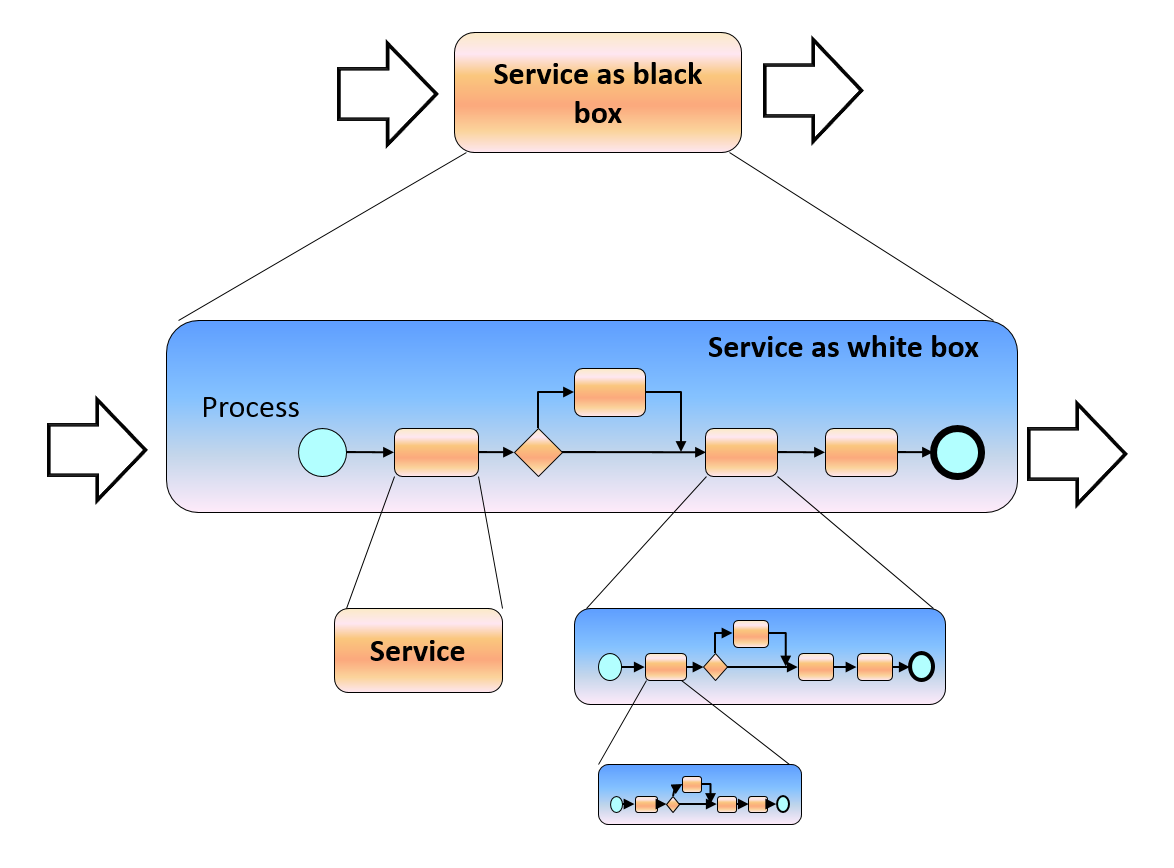
All artefacts are wrapped as services (actually, microservices). A process coordinates (with the use of various coordination techniques – see http://improving-bpm-systems.blogspot.co.uk/2014/03/coordination-techniques-in-bpm.html ) various services and it is a service itself. Thus process is an explicit and executable way to aggregate smaller services into bigger ones. In other words, a process is an aggregated service.


Versioning of artefacts (10.3 from by book http://www.samarin.biz/book )


To achieve the versioning of artefacts it is necessary to understand how to treat relationships between artefacts (see 2.4.4 of the book).

We recommend that a system be evolved via some kind of transformation cycle as shown in Figure 1. Start with a stable configuration of approved artefacts. Then introduce a new version of the artefact B3 which is available only for one consumer (i.e. artefact A2) which has to be also versioned. After achieving higher confidence with these new versions, switch all other consumers (i.e. artefact A1) to the new version of the artefact B3. When it is considered that all new artefacts are functioning correctly, their old versions can be removed. The transformation is over and a stable configuration of approved artefacts is once again reached.


Figure 1 Figure 10.3 “Transformation cycle” from the book 

In a properly architected system, you may carry out several transformation cycles at the same time.

Process-template and process-instance


A process-centric solution have several processes (actually process-template - a formal description of the process) and some stand-alone services (e.g. a stand-alone service may generate an event which launches one of the processes (actually the process-instance of a process-template - enactment of the process template).

The distinction between process template and process instance is very important. The life-cycle of process-template is controlled at design-time. The life-cycle of process instance is controlled at run-time. A process instance is created, maybe suspended & resumed and finally terminated. Many process instances may co-exist at the same time as shown in Figure 2.

Figure 2 Templates and instances


Process-centric artefacts


Process-centric artefacts and relationships between them are the following:
  • The business is driven by events 
  • For each event there is a process to be executed 
  • Process coordinates execution of activities (automated and human and sub-processes) 
  • The execution is carried out in accordance with business rules 
  • Each activity operates with some business objects (data structures and documents) 
  • A group of staff member (business role) is responsible for the execution of each human activity 
  • The execution of business processes produces audit trails 
  • Audit trails (which are very detailed) are also used for the calculation of Key Performance Indicators (KPIs) 
Also, one can read more about artefacts in chapters 7 and 11 of the book.


Events


Evolution of an event is very straightforward – just new version for any change. Usually, there is a mapping (or decision) table (implemented as a “dispatch” service – see 2.6 of the base blogpost) to provide the correspondence between events and processes. In the simplest policy, a particular event is linked to a particular process template (or a particular version of a particular process template). More sophisticated policies are possible, e.g. usage of the most recent version, time-based selected, etc.

Note: Events mays be generated by processes.

Note: Events may be processed via EPN and decision management techniques.

Potential side-effects (evolving together): None at the moment (just explicitly ignore event if it does not launch any processes).


Process-template


Evolution of a process template is evolution of a composite object. The simplest policy is a very strict binding (also called “early binding”) – a particular version of the process template refers to a particular version of each components (actually microservices).

Figure 3 Early binding 

More sophisticated policies are possible, e.g. process-template is using the most recent versions of each component available at the process-instance launching moment (also called “late binding”). Because, the process-template is actually a description then its versioning is not a big problem.

Potential side-effects (evolving together): As life-cycles of a particular process-template and its process-instances do not match, it is necessary to understand what should be done with the running process-instance in case of changing the process-template, although the process-template and its process-instances are different objects (similar to mother and her borne children).


Process-instance


Process-instance is a composite object and its evolution is better to avoid (like changing a running car). Evolution of a process-instance may be necessary for some legal purposes if a long-running process-instance should be modified in accordance with the evolution of related process-template. The related technique is described in http://improving-bpm-systems.blogspot.ch/2010/03/practical-process-patterns-mint.html . Of course, it is better to avoid evolution of process-instance at all, but small changes should be possible.

In practice, the main reason to evolve process-instance is for correcting various errors and exceptions, e.g. in data or in rules or in automation. If some of the components are expected to be quickly evolving or “shaky” then the relationships between the composite and these component should be indirect thus manageable externally.
Figure 4 indirect binding 

Sometimes, it is necessary to create a version of an external component which must be used only by a particular process-instance. In general, all external components are re-usable from various aggregates.


Roles


Roles should be define in a suitable DSL externally from the process template and changes for a particular process instance should be possible. Usual technique is to have a set of dedicated functional roles (Responsible, Accountable, Consulted, Informed) for each human activity within a process and be able to provision these roles by various organisational and other roles externally from the process template.

Rules


Rules is a typical service which is implemented in a DSL (decision management notation). This service is stateless and easy to evolve.

Audit trails


Audit trails are easy to evolve. Ii is important to define them explicitly in processes, for example, like measurement-points. Audit trails must be kept outside the process engine in, for example, an enterprise data warehouse thus be independent from evolution of BPM suite itself. Typical process execution data (start/finish time for each activity, etc.) must be merged with some business data to associate separate process-instances which treated the same business objects.

KPIs


If audit trails are done correctly then KPIs are easy to evolve.

Human activity

Human activity is implemented as an interactive service. Sometimes, such a service is a generic tool (which is external to process-template) and such a tool should receive from the process-instance a reference to a human activity to be treated. This is an example of indirect relationship mentioned above.

Sub-processes


Typically, early or late binding is applied for selecting a version of a sub-process to be used (although it depends on capabilities of the business process engine). In the majority of situations, the late binding works fine – just remember to record the version of a sub-process template used in each invocation.

Data structures


As a good practice, business data structures are kept in a generic format (e.g. SDO) and transferred along the process as a black box. To implement some routing logic, additional technical or process-template-specific data structure is created. Bridging between business and technical data structures is done by in automated activities.

Documents


Documents are kept in external repositories, e.g. a document management system or ECM tool. They are referred via URLs and some metadata. 


Automated activities


Automates activity is the most “shaky” component of the process (as an aggregate). The indirection binding which is used for them is done through a “robot” (see 2.3 in the base blogpost). Robot is a very stable service and the process-instance passes to it the name of the automation script to be executed as well as input and output parameters. The name of the automation script is a process parameter (thus changeable by the process-template administrator and the process-instance administrator) and input/output parameters are SDOs.

The typical error recovery practice discussed below. Figure 5 shows a “container” in which an automated activity “A” operates within the processes. The normal execution sequence is “E1-A-E2”. Because the automated activity may fail, the container contains the intermediate exception event "E3" and an activity for Error Recovery Procedure (ERP).

Figure 5 Error recovery loop and Error Recovery Procedure (ERP) – exception handling 

In case of failure, the recovery execution sequence will be “E1-E3-ERP-E1-A-A2”. ERP may be very trivial (just try again) or more intellectual (try three times and then ask a person to have a look at it).

In additional to exception, it is necessary to define time-out to prevent endless automated activities as shown in Figure 6.
Figure 6 Error recovery loop and Error Recovery Procedure (ERP) – exception and time-out handling 

Automation activity is an automation script which is executed by robot. Typical automation script is an aggregate (usually in an interpreted language) of several micro-services and this aggregate should be executed as a one transaction (see Figure 7).
Figure 7 Execution of an automation script by the robot 

Again, normal execution sequence is “E1-A1-A2-A3-E2”. In case of failure of “A2”, the sequence will be “E1-A1-A2-E3-ERP1-E1-A1-A2-A3-E2”. The double execution of “A1” is possible because of that all micro-services are idempotent (see 2.10 in the base blogpost). If “ERP1” is a human activity then the correction of “A” automation script may be carried out within this human activity.

Note: Processes with only automated activities must be idempotent.

Of course, there is no a robot per each automated activity because the robot must be able to handle concurrently several automation scripts as the same time (as several process-instances of the same process-template may be executed at the same time). Instead, there is a queue of jobs for a group of similar robots. An automation activity of a process-instance puts an automation script into a queue and waits for a robot to execute this script and inform the process-instance that this automation activity is completed (see Figure 8).

Figure 8 Queuing of jobs for robots 

The queue is shared between various process-instances and it is possible to have several specialised queues. The queue size and robots are monitored.

In some sense, robots work as humans – wait for a job from process-instances, execute jobs when they can and inform a particular process-instance that a particular job is completed.

Conclusion


The describe approach was used (since the year 2000) for a production system comprising about 3 000 complex products per year, 50 persons, about 50 different activities, 3 production chains, 6 repositories and 40 IT services (actually, a couple hundred of micro-services). The system was in place for several years. The maintenance and evolution of this production system required several times less resources. Also, several successful (and easy to do) migrations of its big components were undertaken. 

Thanks,
AS


2014-08-12

#BPM for software architects - from monolith applications to explicit and executable #coordination of #microservices architecture

This document is an attempt to outline how BPM (trio: discipline, tools and practices/architecture) can address some concerns of microservices architecture, primarily:
  • avoiding “big ball of mud” syndrome (chapter 3)
  • recovery from error (chapter 4)
  • agility of solutions - will be a separate blogpost, because the primary focus of architecture is not the thing (process, services, etc.) but how the thing changes. (Thanks to Jason Bloomberg ) see http://improving-bpm-systems.blogspot.ch/2014/08/bpm-for-digital-age-shifting.html 
  • defining microservices (chapter 5)
  • making microservices friendly to clouds (chapter 6)
  • enhancing information security (chapter 7)
Thus, this document shows a way from monolithic applications to solutions which are based on explicit and executable Coordination Of MicroServices Architecture (COMSA).

The sources about microservices are, primarily, http://martinfowler.com/articles/microservices.html and http://www.tigerteam.dk/blog

1     About microservices (as the latest incarnation of #SOA)

The blogpost http://www.brunton-spall.co.uk/post/2014/05/21/what-is-a-microservice-and-why-does-it-matter/ defines a microservice as following:
  • A small problem domain (AS: one function with a couple of screens of code ,often created by just a few people)
  • Built and deployed by itself (AS: operationally independent; run on the OS levels; and even ownership independence;– it seems that microservice follows my definition http://www.samarin.biz/terminology/artefacts-important-for-the-bpm-discipline/service )
  • Runs in its own process (AS: again, operationally independent, e.g. in its only JVM)
  • Integrates via well-known interfaces (AS: interface which is implemented language-independent)
  • Owns its own data storage (AS: a microservice may have its own data storage)


2     Implementation techniques for process-centric solutions

Note, you may want to glance at the chapters 9, 10 and 11 (which provide some information about BPM) before reading this chapter.


2.1 Guiding principles

  • Speed of developing automation is the primary factor of agility of a process-centric solution.
  • Automation and process template have different speed of changes – keep automation outside the process template.
  • Automation may be long-running and resource-consuming.
  • Automation may and will fail.
  • Failures maybe because of technical (no access to a web service) or business (missing important data) reasons.
  • Recovery after failure should be easy.
Automation’s problems (failures, resource consuming) must not undermine the performance of process engine.


2.2 Interpretive languages

Business routines are usually built on existing APIs to access different enterprise systems and repositories. They look like scripting fragments to manipulate some services and libraries. Thus, a combination of interpreted and compiled static programming languages will bring extra flexibility – interpreted language for “fluid” services (business routines) and compiled language for “stable” services (libraries, business objects, data). Examples of such combinations are: Jython and Java, Groovy and Java, etc. In combining them, it is important to use the strong typing to secure interfaces, enjoy introspection, and avoid exotic features.

Example in Jython:
#   
# Pending WF
#
# 2001-09-27 AS: Date written
# 2003-04-04 AS: Rewrite
#
# Pre-processing
#
def task_Pre_processing( ) :
   print thisW.getTitle(), "Execute task Pre-processing()"
   l = thisSession.getResource("/iso/baa/_BO.py")
   exec(l)
   BO_initBusinessSession (['pmdb', 'twdb'])
   ID = thisW.getWorkAttributeAsString(thisWP, "ID")
   Language = thisW.getWorkAttributeAsString(thisWP, "Language")
   Languages = thisW.getWorkAttributeAsString(thisWP, "Languages")
#
# Find related BO
#
   dProjectPmdb = aProjectPmdbHome.findBo ( ID )
   if ( not dProjectPmdb.isValid() ) :
      _PytErrorAdmin("No standard in the PMDB ID=%s %s" % (ID, dProjectPmdb.getReturnMessage()))
      return
   pass
# Rename workflow title
   if (thisW.getID() != thisSW.getID() ) : # ? subworkflow ?
      nameW = thisW.getTitle()
      nameSW = thisSW.getTitle()
      thisSW.setTitle(nameSW +" for "+nameW)
   pass
# Display Project's class
   cc = BO_getProjectClass (dProjectPmdb)
   thisW.setMasterManager (string.upper(cc[0:1])+string.lower(cc[1:])) ;
pass
#
# Post-processing
#
def task_Post_processing( ) :
   print thisW.getTitle(), "Execute task Post-processing()"
pass


2.3 Robot as a generic microservice

Keeping microservices for “business routines” outside the process description allows some quick modifications even within a running process instance. The execution of such microservices can be carried out by a universal service which receives a reference to a text fragment to be interpreted, fetches this text fragment and interpret it. We call this service “robot”; universal robots and specialised robots may co-exist. Robots must be clonable (for scalability, load-balancing and fault-tolerance).

A crash of a robot will not disturb the process engine except that the activity, which caused the crash, will be marked in the process instance as “late” or “overdue”.

2.4 Monitoring

  • Ruthless monitoring of all services (including robots, other systems and repositories).
  • Not just checking that a port is bound, but asking to do a real work; for example, echo-test.
  • Service should be developed in the way to facilitate such a monitoring.
  • System should be developed in a way to facilitate such a monitoring.
  • Also, robots proactively (before executing automation scripts) must check (via monitoring) the availability of services to be used in a particular automation script.
  • It is better to wait a little than recover from an error.

2.5 Explicit versioning of everything

The intrinsic separation between process template and individual process instance in process-centric solutions allows the use the full power of microservice versioning. A lot of variants are possible:
  • Process instance may use the “current” version of a particular microservice.
  • Process instance may use the particular version of a particular microservice.
  • In case of some compliance requirement:
    1. Since 1st of April all new process instances will use process template v2
    2. Already running process instances must remain at process template v1
  • Some already running process instances will remain at process template v1 (if those instances are close to the completion)
  • Some already running process instances may be migrated to process template v2 (if those instances are far from the completion)
Thus everything (process templates, XSD, WSDL, services, namespaces, documents, etc.) must be explicitly versioned and many versions of the “same” should easily co-exist. We also recommend to use the simplest version schema – just sequential numbering: 1, 2, 3, etc.

2.6 Use of other types of coordination in addition to classic process templates

Business rules is another DSL which is very popular in BPM. We recommend to follow the TDM approach ( see http://www.kpiusa.com/ ).

We recommend centralising the treatment of important business events (all external ones and some internal ones) as one service called “dispatch”. The “dispatch” service analyses business events and decides which business process should be initiated. Each process should send to this service an internal business event when the work has been completed (see Figure 1).

Figure 1 “Dispatch” service carries out coordination of processes

See also EPN and BPMN "Explicit event processing agents in BPMN?" at http://improving-bpm-systems.blogspot.com/2011/01/explicit-event-processing-agents-in.html .

2.7 Pattern PDP (Pre-processing, Doing, Post-processing)

Frequently work is divided into three parts (see Figure 2):
  • pre-processing or preparation, e.g. receipt of information from various sources in different formats, or from different repositories, and conversion into a standard presentation;
  • doing or processing, i.e. data or information processing in accordance with a standard presentation;
  • post-processing or finalisation, e.g. conversion from a standard presentation into a particular presentation.
Figure 2 The PDP pattern

Note, the PDP pattern may be used at the scale of the whole processes.

2.8 Pattern AHA (Automated, Human and Automated)

The AHA pattern is a variant of the PDP pattern aimed at facilitating human work, e.g. collection of data and maybe documents for a human activity (in the same way as a good assistant prepares documents for his/her boss) followed by automation of the follow-up activities. We recommend using this pattern to model all intellectual and verification human activities (see Figure 3).

Figure 3 The AHA pattern

Although in some cases the analysis may define that the pre- or post-processing activity is empty, we recommend that these activities are always inserted – in this way the addition of some automation later will be easy because no changes to the process will be required.

2.9 Pattern ERL (Error Recovery Loop)

Any service invoked within a process may fail. The error must be acted upon in some way, e.g. to re-invoke a service, or to suspend or terminate the process. Figure 4shows a possible approach to treat a service failure – here we ask a human to do something to correct the service and then re-invoke the service. In this diagram we consider that the activity Service returns an error flag which is analysed in the gateway G01.

Figure 4 The ERL pattern (with error return)

If the activity Service raises an exception then the diagram should be as shown in Figure 5.

Figure 5 The ERL pattern (with exception). Note, after “Error recovery” activity the execution continues from the end of respective sub-process, i.e. just before the gateway “G01”. 

Activity “Error recovery” may be a human activity for a person who is responsible to carry out necessary corrections actions. Depending on the kind of error, this activity may be assigned to different people.

2.10 Pattern IRIS (Integrity Reached via Idempotency of Services)

To achieve integrity within a process, shall we use the ERL pattern “around” each invocation of a service or not? In general yes, but idempotent services can be grouped (as shown in Figure 6). Idempotency of a service means that it can be invoked many times with the same effect. Any state-less service is idempotent. Some state-full services can have this quality also, e.g. a service to add a new version to a document may ignore the request if the most recent version of this document is exactly the same as the requested one.

The process in Figure 6 may have the following audit trail:
  • Activity01 – finished
  • Activity02 – failed and raised an exception
  • Error Recovery – did something
  • Activity01 – finished again thanks to idempotency
  • Activity02 – finished
  • Activity03 – finished
Figure 6 The IRIS pattern. Note, after “Error recovery” activity the execution continues from the end of respective sub-process, i.e. just before the gateway “G01”.

Note, idempotence (pron.: /ˌaɪdɨmˈpoʊtəns/ eye-dəm-poh-təns) is the property of certain operations, that can be applied multiple times without changing the result beyond the initial application.

3 Avoiding “distributed big balls of mud”

This problem was mentioned in the blogpost http://www.codingthearchitecture.com/2014/07/06/distributed_big_balls_of_mud.html with Figure 7 and next quote:

If you can't build a monolith, what makes you think microservices are the answer? If teams find it hard to create a well structured monolith, I don't rate their chances of creating a well structured microservices architecture. As Michael Feathers recently said (in https://michaelfeathers.silvrback.com/microservices-until-macro-complexity) , "There's a bit of overhead involved in implementing each microservice. If they ever become as easy to create as classes, people will have a freer hand to create trouble - hulking monoliths at a different scale.". I agree. A world of distributed big balls of mud worries me.


Certainly, I can see a lot of similarities between microservices architecture and process-centric solutions in Figure 8 which is from my book about BPM ( www.samarin.biz/book ), published in the year 2009.

Figure 8 Disassembling monolith into services and assemble them via coordination

The question is how to coordinate separate microservices. The obvious choice is ESB (as shown in Figure 9).
Figure 9 Flow of data

This means that all microservices should be on this picture with potential connectivity everyone to everyone which has the N*(N-1)/2 complexity. Where N is number of microservices resulting in “explosion” of an application. We estimate this number at about 100 per application (or 300 from http://www.infoq.com/interviews/goldberg-microservices).

Also a couple of issues from ZapThink http://www.zapthink.com/2013/05/21/cloud-friendly-bpm-the-power-of-hypermedia-oriented-architecture/
  1. Where to keep the state for this composite service (i.e. ex-application)? If in ESB then this makes ESB too complicated.
  2. Is ESB cloud-friendly? Just imaging a re-start of the VM with the ESB.
It seems that ESB is necessary but not sufficient. What is missing? We believe that the flow of control is more important than the flow of data (as shown in Figure 10).

Figure 10 Flow of control

In the former, the primary importance is exchange of data. In the latter, the primary importance is the result of working together, but not individual exchanges of data (like in football). Of course, both are necessary, but only ESB is not enough. Considering that more than one coordination techniques may be used by a solution then Figure 11 is more realistic.

Figure 11 Several coordination techniques

The issues (complexity, state and cloud) are answered as following:
  • Complexity is much lower because only “business routine” services (which are interacting with the process) are depicted.
  • State is discussed in chapter 4.
  • Cloud-friendliness is discussed in chapter 6.
Also, some classification of microservices may be added:
  • explicit coordination (orchestration, cooperation, biz rules, event processing)
  • functional components (like elementary filters in UNIX pipes)
  • functional aggregations (e.g. combination of functional components)
  • data storages
  • data aggregations (i.e. combination data from several data storages)
  • human (interactive) 
  • and some combinations of the previous
This classification helps to understand which microservices may be provisioned from clouds.

4 Easy recovering from errors (by design)

We all know that the main difference between a monolithic applications and distributed solutions is in the error recovery practices. We need distributed solutions because of the scalability, fault-tolerance and cloud-based provisioning. At the same time, we have to architect the recovery from losing connectivity between nodes and service failure (VM reloading or note failure).

If a subordinated service (relatively to the coordination service) has failed then the coordination service will recover via error recovery loop (see 2.8 and 2.9).

If the coordination service has failed then some of running its subordinated services cannot complete their associated activities; after the restart of the coordination service, those activities will fail by timeout (because each activity has its SLA).

If a resource may change its state without the control of the process then the process must interrogate the state of such a resource before its usage.

Because of processes which provide clear and detailed context, the identification of problems is very quick.

5 Defining microservices

BPM helps to provide context, define, coordinate microservices. It helps to eliminate endless discussions about the necessary “granularity” of the services:

“If we select a top-down style then we will create coarse-grained business-related services, but we are not sure whether such services are implementable or reusable. If we follow a bottom-up style then we will implement too many fine-grained services for which the business value is not obvious.”

Actually, the native flexibility business processes and explicit versioning allow the rapid and painless adaptation of services to increase or decrease their granularity. Any wrong decisions are easily corrected; services are quickly adapted to the required granularity.

6 Explicit allocation of microservices to clouds

See http://improving-bpm-systems.blogspot.ch/2011/12/enterprise-pattern-cloud-ready.html

7 Enhancing information security

See http://improving-bpm-systems.blogspot.ch/2014/04/ideas-for-bpmshift-delenda-est-vendor.html and related PPT http://improving-bpm-systems.blogspot.ch/2013/04/addressing-security-concerns-through-bpm.html

8 Characteristics of a Microservice Architecture annotated

These characteristics are from http://martinfowler.com/articles/microservices.html

8.1 Componentization via Services

Definition: component is a unit of software that is independently replaceable and upgradeable.
BPM helps to define services.

8.2 Organized around Business Capabilities

Microservices, which, in majority, implement various business artefacts, naturally grow around business capabilities.

8.3 Products not Projects

The three different types of projects appear instead of classic projects:
  1. Mini-project for developing process-centric solutions (including new microservices)
  2. Architectural evolution of common components TOGETHER
  3. Implementation of common components (e.g. BPM suite tool)
Architecture-based agile project management (archibagile) may be useful for mini-projects. ( see http://improving-bpm-systems.blogspot.ch/2014/06/different-coordination-techniques-in.html ).

8.4 Smart endpoints and dumb pipes

Sure, ESB just a reliable communication mechanism without any business intelligence. Everything is happened in services, even process-centric coordination.

8.5 Decentralized Governance

Sure.

8.6 Decentralized Data Management

Sure again.

8.7 Infrastructure Automation

Yes, also process provides the context for services thus test cases. Process itself is an integration test for its services.

8.8 Design for failure

Sure.

8.9 Evolutionary Design

There are several tempos of design: process, process-specific microservices, common microservices, common operating environment (testing, deployment, monitoring, etc.) and the overall architecture.

Processes make easier to use the power of total versioning. Thus process-specific microservices should mature very quickly.

9 Briefly about Business Process Management (BPM)

BPM (see Figure 12) is a trio: 1) discipline how to better manage an enterprise, 2) COTS and FOSS tools known as BPM suite and 3) an enterprise portfolio of the business processes as well as the practices and tools for governing the design, execution and evolution of this portfolio.

Figure 12 BPM as a trio

The key concept of BPM is business process which is explicitly-defined coordination for guiding the purposeful enactment of business activity flows. In other words, a business process is an agreed plan which is followed each time a defined sequence of activities is carried out; the plan may include some variants and will possibly allow for some unplanned (i.e. unanticipated) changes. (see other BPM-related definitions http://improving-bpm-systems.blogspot.ch/2014/01/definition-of-bpm-and-related-terms.html ).

The operative word in the above definition is coordination. Although business processes are often associated with only one coordination technique known as template (workflow-like and BPEL-like fixed logic for sequencing activities), there are many coordination techniques (see http://improving-bpm-systems.blogspot.ch/2014/03/coordination-techniques-in-bpm.html ). The most popular from them are various data-based (also rule-based, decision-based, intelligence-based) and event-based (see EPN - http://improving-bpm-systems.blogspot.fr/2011/01/explicit-event-processing-agents-in.html ) coordination techniques.

From the behavioural (or dynamic) point of view, various coordination techniques are necessary to provide enough flexibility to realise various variants of BPM usage – see http://improving-bpm-systems.blogspot.ch/2010/12/illustrations-for-bpm-acm-case.html .

From the structural (or static) point of view, an enterprise can be presented as a system of processes which comprises various coordination constructs of different granularity (process patterns, processes per se, clusters of processes and value-streams) formed via various coordination techniques (see http://improving-bpm-systems.blogspot.ch/2014/03/enterprise-as-system-of-processes.html ).

For software architects, it is important to know BPM consider business processes explicit (i.e. formally defined to be understandable by different participants) and executable (conceptually, the process instance executes itself, following the BPM practitioner’s model, but unfolding independent of the BPM practitioner; process instances are performed or enacted, which may include automated aspects).

P.S: Various ways how a company can benefit from a BPM are listed in http://improving-bpm-systems.blogspot.ch/2014/05/ideas-for-bpmshift-delenda-est-vendor_9.html

10 Structuring executable processes and services

An executable process coordinates the execution of some services. Such a process is expressed in a particular language (i.e. BPMN) and it invokes some services. In Figure 13, the process is in the pool “COOR”, interactive services are in the two pools above it and automated services are in the two pools below it. Note, BPMN is a typical DSL.

Figure 13 Process coordinates some services

This is a classic picture, but how to bring microservices to it?

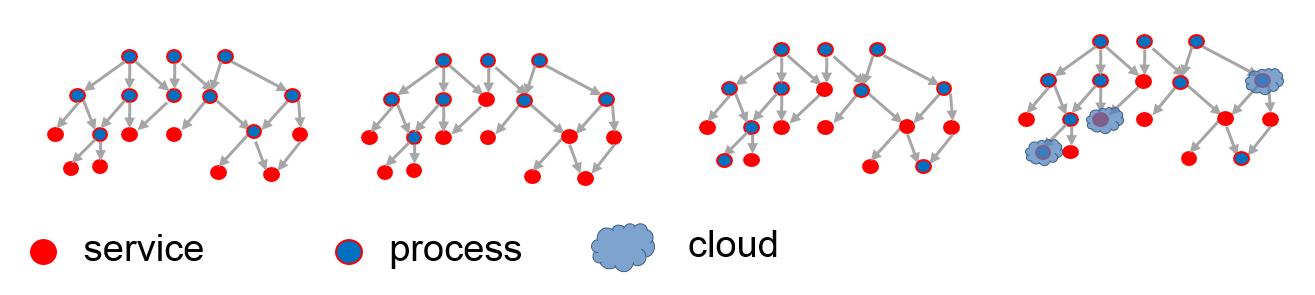
Each enterprise is a complex, dynamic, unique (for each enterprise) and recursive (i.e. like “Russian doll”) relationship (see Figure 14) between services and processes:
  • All processes are services
  • Some operations of a service can be implemented as a process
  • A process includes services in its implementation
 
Figure 14 Recursive nature of relationship between processes and services

Thus, some “big” services are implemented as explicit and executable processes until only microservices are used.

The relationship does not force to have a “pure” structure, but brings flexibility of converting processes to services and vice-versa as necessary, e.g. to use services provisioned from cloud (as shown in Figure 15).

Figure 15 Structure of process and services

Note that the business process modelling procedure should take care about decomposing a big service into smaller services which are coordinated by the process. Different people in similar situations should find similar services (especially, microservices) although that such a decomposition is creative work. Example of such a modelling procedure is in http://improving-bpm-systems.blogspot.ch/2013/07/bpm-for-business-analysist-modelling.html .

11 Multi-layered structuring of process-centric solutions

Because a process coordinates various business artefacts , e.g. “Who (roles) is doing What (business objects), When (coordination of activities), Why (business rules), How (business activities) and with Which Results (performance indicators)”, these artefacts can be structured around processes.

This structure arranges different artefacts on separate layers as shown in Figure 16. Each layer is a level of abstraction of the business and addresses some particular concerns.

Figure 16 Multi-level implementation model

More details are available from http://improving-bpm-systems.blogspot.ch/2011/07/enterprise-patterns-caps.html

Each layer has two roles: it exploits the functionalities of the lower layer, and it serves the higher layer. Each layer has a well-defined interface and its implementation is independent of that of the others. Each layer comprises many services that can be used independently – it is not necessary that all layers be fully implemented at the same time or even be provided in a single project.

Another practical observation is that different layers have lifecycles of different time scales: typical repositories have a 5- to 10-year life-span while the business requires continuous improvement. Because of the implementation independence of the different layers, each layer may evolve at its own pace without being hampered by the others.

Business objects, routines, processes, KPIs, events, rules, audit trails, roles, etc. are the first candidates for microservices which implement particular artefacts.

Thanks,
AS