<discussion ref="http://www.linkedin.com/groupAnswers?viewQuestionAndAnswers=&gid=73876&discussionID=7700343&commentID=7157602#commentID_7157602" />
At present, we have vendor-centric BPM and this is good ... for vendors. At the same time we don’t have a commonly agreed BPM reference model, or a good set of standards (e.g. for exchange diagrams between different tools), etc.
I believe that it is time that BPM progresses from being vendor-centric to become customer-centric. A good example of customer-centricity is the current situation with web browsers – all vendors of web browsers want to benchmark their product against the ACID3 test (acid3.acidtests.org) to demonstrate their compliance with standards. Once such a baseline has been established, it becomes easy to compare the performance of products. I hope that a similar tendency will be established in the BPM field whereby vendors of BPM software will compete in terms of compliance with standards and product performance.
Interesting that the W3C maintain a coherent set of standards for HTML:
a) xHTML for structure and content,
b) CSS for presentation,
c) DOM-based API for dynamic modifications, and
d) some other specialized standards.
Wish that we can have something similar in BPM.
Thanks,
AS
Showing posts with label From vendor-centric BPM to customer-centric BPM. Show all posts
Showing posts with label From vendor-centric BPM to customer-centric BPM. Show all posts
2009-10-06


2009-10-01
Blog: Demo vs. Production BPM-based Systems
<discussion ref="http://mainthing.ru/item/212/" />
Bravo, Anatoly. This is an excellent overview of some problems originated in mixing of "BPM as software" (a.k.a. BPM suite) and "enterprise BPM system" (what is implemented within an enterprise to manage its business processes). See also --- http://improving-bpm-systems.blogspot.com/2009/04/should-we-consider-third-forgotten-bpm.html
Sure that a modern BPM suite is necessary, but not sufficient for a good enterprise BPM system - "an aircraft carrier should never operate alone".
In the absence of agreed reference models and proper standards, creating good enterprise BPM systems implies serious architecting efforts. Below I comment your list from the architectural point of view.
1. Your own enterprise "worklist" application has to be considered regardless of a BPM suite "web portal". The users want to handle business processes in conjunction with their business objects, e.g. business cases.
2. Business events (receiving an order) are often already available somewhere in your enterprise systems. Just link them with your processes.
3. Automatically generated forms are usually considered only for quick prototyping.
4. Existing reports are usually considered only for quick prototyping.
5. By definition, business objects as BPM artefacts have to be externalised. Dreaming to keep them within a BPM suite is wrong from the beginning.
6. Audit trails and KPI are other BPM artefacts -- put them out of a BPM suite, by definition.
7. Documents are yet another BPM artefacts. Keep them out and do not forget about records management.
8. Handling of roles (also a BPM artefact) is usually difficult. I usually recommend to create a set of groups oriented to processes, e.g. process owner, activity workers, etc. and to populate these groups from available resources (processes are useful for that).
9. Agree - patterns and anti-patterns are necessary for constructions of complex processes (see my blog http://improving-bpm-systems.blogspot.com/ for some practical process patterns).
I think that any discussion about the architecture of enterprise BPM systems is step from the current vendor-centric BPM to customer-centric BPM.
Thanks,
AS
Bravo, Anatoly. This is an excellent overview of some problems originated in mixing of "BPM as software" (a.k.a. BPM suite) and "enterprise BPM system" (what is implemented within an enterprise to manage its business processes). See also --- http://improving-bpm-systems.blogspot.com/2009/04/should-we-consider-third-forgotten-bpm.html
Sure that a modern BPM suite is necessary, but not sufficient for a good enterprise BPM system - "an aircraft carrier should never operate alone".
In the absence of agreed reference models and proper standards, creating good enterprise BPM systems implies serious architecting efforts. Below I comment your list from the architectural point of view.
1. Your own enterprise "worklist" application has to be considered regardless of a BPM suite "web portal". The users want to handle business processes in conjunction with their business objects, e.g. business cases.
2. Business events (receiving an order) are often already available somewhere in your enterprise systems. Just link them with your processes.
3. Automatically generated forms are usually considered only for quick prototyping.
4. Existing reports are usually considered only for quick prototyping.
5. By definition, business objects as BPM artefacts have to be externalised. Dreaming to keep them within a BPM suite is wrong from the beginning.
6. Audit trails and KPI are other BPM artefacts -- put them out of a BPM suite, by definition.
7. Documents are yet another BPM artefacts. Keep them out and do not forget about records management.
8. Handling of roles (also a BPM artefact) is usually difficult. I usually recommend to create a set of groups oriented to processes, e.g. process owner, activity workers, etc. and to populate these groups from available resources (processes are useful for that).
9. Agree - patterns and anti-patterns are necessary for constructions of complex processes (see my blog http://improving-bpm-systems.blogspot.com/ for some practical process patterns).
I think that any discussion about the architecture of enterprise BPM systems is step from the current vendor-centric BPM to customer-centric BPM.
Thanks,
AS
2009-05-18
BPMNEXUS: BP Notations
<discussion ref="http://bpmnexus.ning.com/forum/topics/bp-notations" />
A short answer - there is no a commonly agreed BPM reference model which can give a context for BP notations.
An explanation by example. In my BPM reference model, BPM discipline allows you to model, automate, execute, control, measure and optimise the flow of business activities that span the enterprise’s systems, employees, customers and partners within and beyond the enterprise boundaries.
The main difference of the BPM discipline from previous process-centric methodologies is the need to have a single formal description of the business processes which can be used to model, automate, execute, control, measure and optimise them.
Agree with Ricardo, that expressing of business processes in any notation should serve to communication between people. But, I believe, such a notation should be also executable to validate that communication. (just a sidenote -- I think that any program code should be written to communicate a solution between people.)
So,
• A BPMN-like modelling notation should use a standard execution semantic which can be validated and which guarantees the adequate interpretation of models by different software for different uses, e.g. for functional testing, performance simulation and execution. (I think, this is similar to Brian's post).
• It should be possible to represent the same business process model with different levels of detail, e.g. a high-level view for a normal user, and a more detail for a business analyst.
• There should be a modelling procedure which guides different people how to use these different levels.
• Details of the execution of business processes should come from a coherent set of standards, similar to that provided by the W3C for HTML: a) xHTML for structure and content, b) CSS for presentation, c) DOM-based API for dynamic modifications, and d) some other specialized standards. (At present, W3C works also on some recommendations for HTML5 which include several API for Web application, i.e. the execution environment.)
It seems that W3C standardisation approach for HTML is rather solid. I like it as a good example of customer-centricity which is proved by the current situation with Web browsers – all vendors of Web browsers want to benchmark their product against the ACID3 test (acid3.acidtests.org) to demonstrate their compliance with standards. Once such a baseline has been established, it becomes easy to compare the performance of products.
I think that the current BPM is still vendor-centric and we have to make customer-centric BPM.
Thanks,
AS
A short answer - there is no a commonly agreed BPM reference model which can give a context for BP notations.
An explanation by example. In my BPM reference model, BPM discipline allows you to model, automate, execute, control, measure and optimise the flow of business activities that span the enterprise’s systems, employees, customers and partners within and beyond the enterprise boundaries.
The main difference of the BPM discipline from previous process-centric methodologies is the need to have a single formal description of the business processes which can be used to model, automate, execute, control, measure and optimise them.
Agree with Ricardo, that expressing of business processes in any notation should serve to communication between people. But, I believe, such a notation should be also executable to validate that communication. (just a sidenote -- I think that any program code should be written to communicate a solution between people.)
So,
• A BPMN-like modelling notation should use a standard execution semantic which can be validated and which guarantees the adequate interpretation of models by different software for different uses, e.g. for functional testing, performance simulation and execution. (I think, this is similar to Brian's post).
• It should be possible to represent the same business process model with different levels of detail, e.g. a high-level view for a normal user, and a more detail for a business analyst.
• There should be a modelling procedure which guides different people how to use these different levels.
• Details of the execution of business processes should come from a coherent set of standards, similar to that provided by the W3C for HTML: a) xHTML for structure and content, b) CSS for presentation, c) DOM-based API for dynamic modifications, and d) some other specialized standards. (At present, W3C works also on some recommendations for HTML5 which include several API for Web application, i.e. the execution environment.)
It seems that W3C standardisation approach for HTML is rather solid. I like it as a good example of customer-centricity which is proved by the current situation with Web browsers – all vendors of Web browsers want to benchmark their product against the ACID3 test (acid3.acidtests.org) to demonstrate their compliance with standards. Once such a baseline has been established, it becomes easy to compare the performance of products.
I think that the current BPM is still vendor-centric and we have to make customer-centric BPM.
Thanks,
AS
2009-04-03
Linkedin: BPM Babylonia - Comparing BPA and BPMS is like comparing apples and oranges
<post ref="http://www.arisblog.com/2009/04/02/bpm-babylonia-%e2%80%93-comparing-bpa-and-bpms-is-like-comparing-apples-and-oranges">
BPM Babylonia - Comparing BPA and BPMS is like comparing apples and oranges"
</post>
I think, considering BPA and BPMS as diffenret things is to bring an artificial barrier for bPM within enterprises (see http://improving-bpm-systems.blogspot.com/2009/04/should-we-consider-third-forgotten-bpm.html for "thrid BPM") .
I believe that people in enterprises and projects should consider by themselves where modelling stops and execution starts -- not tools.
This would be the fisrt step from vendor-cenric BPM to customer-centric BPM.
Thanks,
AS
BPM Babylonia - Comparing BPA and BPMS is like comparing apples and oranges"
</post>
I think, considering BPA and BPMS as diffenret things is to bring an artificial barrier for bPM within enterprises (see http://improving-bpm-systems.blogspot.com/2009/04/should-we-consider-third-forgotten-bpm.html for "thrid BPM") .
I believe that people in enterprises and projects should consider by themselves where modelling stops and execution starts -- not tools.
This would be the fisrt step from vendor-cenric BPM to customer-centric BPM.
Thanks,
AS
Should we consider third (forgotten) BPM?
First BPM - management methodlogies to have process orientation
Second BPM -- software tools (a.k.a. BPM suite or BPMS)
Third (forgotten) BPM - a portfolio of business processes of the enterprise, as well as the practices and tools for governing the design, execution and evolution of this portfolio as a system
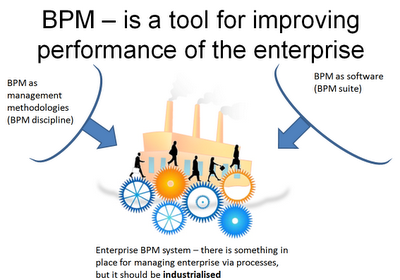
I think, our effofts should be dedicated to this third BPM.
Tjanks,
AS
Second BPM -- software tools (a.k.a. BPM suite or BPMS)
Third (forgotten) BPM - a portfolio of business processes of the enterprise, as well as the practices and tools for governing the design, execution and evolution of this portfolio as a system

I think, our effofts should be dedicated to this third BPM.
Tjanks,
AS
2009-04-02
Linkedin: Does the world need a BPM Manifesto ?
<discussion group="BP Group">
Does the world need a BPM Manifesto ?
I have to ask, with all the furore the Cloud Manifesto has created, does our world need a once-and-done framework to finally define the who, what, why, where, how ?
</discussion>
My opinion - BPM needs a reference model and some reference architectures.
Those are initial steps to move from vendor-centric BPM to customer-centric BPM.
I would be happy to participate and bring my contribution:
- some BPM terminology http://improving-bpm-systems.com/terminology/business-related-terminology
- BPM reference model http://www.osp.ru/os/2009/01/7195011/
Thanks,
AS
Does the world need a BPM Manifesto ?
I have to ask, with all the furore the Cloud Manifesto has created, does our world need a once-and-done framework to finally define the who, what, why, where, how ?
</discussion>
My opinion - BPM needs a reference model and some reference architectures.
Those are initial steps to move from vendor-centric BPM to customer-centric BPM.
I would be happy to participate and bring my contribution:
- some BPM terminology http://improving-bpm-systems.com/terminology/business-related-terminology
- BPM reference model http://www.osp.ru/os/2009/01/7195011/
Thanks,
AS
2009-03-16
LinkedIn: What is BPM?
<discussion news="What is BPM?">
http://www.linkedin.com/newsArticle?viewDiscussion=&articleID=26422661&gid=1062077
</discussion>
Agree with Ilia - terminology is needed, as well as, a BPM reference model and a few BPM reference architectures. Those (of course, commonly agreed) are the base to explain to any customer how BPM can address his/her concerns and how BPM can change his/her work for the better.
I believe this is a way to transform the current vendor-centric BPM into customer-centric BPM.
I would be happy to participate in the development of common BPM terminology (my contribution - http://improving-bpm-systems.com/terminology/business-related-terminology), BPM reference model (my contribution - http://www.osp.ru/os/2009/01/7195011/) and reference architectures.
Thanks,
AS
http://www.linkedin.com/newsArticle?viewDiscussion=&articleID=26422661&gid=1062077
</discussion>
Agree with Ilia - terminology is needed, as well as, a BPM reference model and a few BPM reference architectures. Those (of course, commonly agreed) are the base to explain to any customer how BPM can address his/her concerns and how BPM can change his/her work for the better.
I believe this is a way to transform the current vendor-centric BPM into customer-centric BPM.
I would be happy to participate in the development of common BPM terminology (my contribution - http://improving-bpm-systems.com/terminology/business-related-terminology), BPM reference model (my contribution - http://www.osp.ru/os/2009/01/7195011/) and reference architectures.
Thanks,
AS
2009-03-11
BPM reference model
An article "BPM reference model" was published in a russian IT magazine "Open systems". See http://www.osp.ru/os/2009/01/7195011/
Thanks,
AS
Thanks,
AS
2009-02-03
re re BPMN for People and Robots
<post blog="Process Is The Main Thing">
BPMN for People and Robots, comment 10
...
</post >
Anatoly,
I am glad that this discussion turned to the description of a better BPM. I like your list and believe that such a list should include more BPM functionality, not just modelling.
For example, my list of essential requirements for the ideal process development tool (which is an extension of the modern process modelling tools).
• A BPMN-like modelling notation should use a standard execution semantic which can be validated and which guarantees the adequate interpretation of models by different software for different uses, e.g. for functional testing, performance simulation and execution.
• It should be possible to represent the same business process model with different levels of detail, e.g. a high-level view for a normal user, and a more detail for a business analyst.
• There should be a modelling procedure which guides different stakeholders how to use these different levels.
• Details of the execution of business processes should come from a coherent set of standards, similar to that provided by the W3C for HTML: a) xHTML for structure and content, b) CSS for presentation, c) DOM-based API for dynamic modifications, and d) some other specialized standards.
• Different types of artefact should be easily accessible from a business process development environment.
• It should be easy to plug additional DSL-like tools for the explicit definition of relationships between artefacts into the business process development environment.
• It should be possible to reduce and eventually eliminate the need for the explicit use of intermediate formats such as BPEL and XPDL.
• It should be possible to offer some techniques for improving the comprehensibility of business processes by all stakeholders.
I believe that it is time that BPM progresses from being vendor-centric to become customer-centric. A good example of customer-centricity is the current situation with Web browsers – all vendors of Web browsers want to benchmark their product against the ACID3 test (acid3.acidtests.org) to demonstrate their compliance with standards. Once such a baseline has been established, it becomes easy to compare the performance of products.
I hope that a similar tendency will be established in the BPM field whereby vendors of BPM software will compete in terms of compliance with standards and product performance.
But, as the first step, we need an agreed BPM reference model, of course.
Thanks,
AS
BPMN for People and Robots, comment 10
...
</post >
Anatoly,
I am glad that this discussion turned to the description of a better BPM. I like your list and believe that such a list should include more BPM functionality, not just modelling.
For example, my list of essential requirements for the ideal process development tool (which is an extension of the modern process modelling tools).
• A BPMN-like modelling notation should use a standard execution semantic which can be validated and which guarantees the adequate interpretation of models by different software for different uses, e.g. for functional testing, performance simulation and execution.
• It should be possible to represent the same business process model with different levels of detail, e.g. a high-level view for a normal user, and a more detail for a business analyst.
• There should be a modelling procedure which guides different stakeholders how to use these different levels.
• Details of the execution of business processes should come from a coherent set of standards, similar to that provided by the W3C for HTML: a) xHTML for structure and content, b) CSS for presentation, c) DOM-based API for dynamic modifications, and d) some other specialized standards.
• Different types of artefact should be easily accessible from a business process development environment.
• It should be easy to plug additional DSL-like tools for the explicit definition of relationships between artefacts into the business process development environment.
• It should be possible to reduce and eventually eliminate the need for the explicit use of intermediate formats such as BPEL and XPDL.
• It should be possible to offer some techniques for improving the comprehensibility of business processes by all stakeholders.
I believe that it is time that BPM progresses from being vendor-centric to become customer-centric. A good example of customer-centricity is the current situation with Web browsers – all vendors of Web browsers want to benchmark their product against the ACID3 test (acid3.acidtests.org) to demonstrate their compliance with standards. Once such a baseline has been established, it becomes easy to compare the performance of products.
I hope that a similar tendency will be established in the BPM field whereby vendors of BPM software will compete in terms of compliance with standards and product performance.
But, as the first step, we need an agreed BPM reference model, of course.
Thanks,
AS
2008-11-07
LinkedIn: Is it now time for Process professionals to step up to the plate to make significant performance improvements at your financial institution?
<question group="BP Group">
Is it now time for Process professionals to step up to the plate to make significant performance improvements at your financial institution?
Why will your CEO find it difficult to take your advice?
There has never been a more difficult time for financial institutions in the last 100 years and more than ever they need the contribution of the Process professionals. And yet CEOs, CFOs and COOs are highly sceptical about the contribution that process thinking can provide.
- Why is this the case?
- So how can you bridge this credibility divide?
- What should you do now?
Read more from the International Banking Systems featured interview with me at http://tinyurl.com/6xdpnw
Fedback and comments welscome here on the challenges discussed.
Regards John
www.ibspublishing.com/index.cfm?section=features&action=view&id=12544
</question>
We observed that architecting/implementing BPM systems requires a lot of communication with practically everyone within the enterprise and everyone should be treated as a stakeholder of the BPM system.
Each group of stakeholder has different views, different concerns
and different understandings of the BPM system. Those groups are:
• top managers
• business managers
• process owners
• super-users
• users
• project managers
• business analysts
• IT managers
• IT architects
• IT developers
• IT operators
It is mandatory to explain to each stakeholder (not just CxO) how their concerns will be addressed and how their current working practices will be changed for the better.
If all subordinates are happy with a new tool, i.e. the BPM system, then CxO has "no choice".
Have a look at my presentation this summer in Bangalore - http://www.improving-bpm-systems.com/pubs/AS-AW08-keynote.pdf
Thanks,
AS
BPM system is a portfolio of business processes of an enterprise as well as the practices and tools for governing its design, execution and evolution.
Of course, a BPM suite (coherent set of software tools) should be used to facilitate implementation of the BPM system.
Is it now time for Process professionals to step up to the plate to make significant performance improvements at your financial institution?
Why will your CEO find it difficult to take your advice?
There has never been a more difficult time for financial institutions in the last 100 years and more than ever they need the contribution of the Process professionals. And yet CEOs, CFOs and COOs are highly sceptical about the contribution that process thinking can provide.
- Why is this the case?
- So how can you bridge this credibility divide?
- What should you do now?
Read more from the International Banking Systems featured interview with me at http://tinyurl.com/6xdpnw
Fedback and comments welscome here on the challenges discussed.
Regards John
www.ibspublishing.com/index.cfm?section=features&action=view&id=12544
</question>
We observed that architecting/implementing BPM systems requires a lot of communication with practically everyone within the enterprise and everyone should be treated as a stakeholder of the BPM system.
Each group of stakeholder has different views, different concerns
and different understandings of the BPM system. Those groups are:
• top managers
• business managers
• process owners
• super-users
• users
• project managers
• business analysts
• IT managers
• IT architects
• IT developers
• IT operators
It is mandatory to explain to each stakeholder (not just CxO) how their concerns will be addressed and how their current working practices will be changed for the better.
If all subordinates are happy with a new tool, i.e. the BPM system, then CxO has "no choice".
Have a look at my presentation this summer in Bangalore - http://www.improving-bpm-systems.com/pubs/AS-AW08-keynote.pdf
Thanks,
AS
BPM system is a portfolio of business processes of an enterprise as well as the practices and tools for governing its design, execution and evolution.
Of course, a BPM suite (coherent set of software tools) should be used to facilitate implementation of the BPM system.
Subscribe to:
Posts (Atom)


 Posts
Posts

