Showing posts with label Delenda est "vendor-centric #BPM". Show all posts

2014-05-11

Ideas for #BPMshift - Delenda est "vendor-centric #BPM" - Does BPM help with 50% of EA #entarch ?

BPM as a trio of methodology, architecture/practice and tools (often COTS or FOSS) defines a lot for enterprise architecture.

Let us see at the TOGAF layers: (values are approximate and calculated on number of non-trivial issues)
  • 60 % of business architecture
  • 50 % of data/information architecture
  • 70 % of application architecture
  • 20 % of technology architecture 

(60+50+70+20) / 400 = 200 / 400 = 50/100

In addition,
  1. BPM can improve information security (see http://improving-bpm-systems.blogspot.ch/2014/04/ideas-for-bpmshift-delenda-est-vendor.html ).
  2. BPM provides a powerful company-wide governance capability because a company is a system of processes (see http://improving-bpm-systems.blogspot.no/2014/03/enterprise-as-system-of-processes.html ).

Maybe to start your EA from a properly architected  BPM? Benefits are huge - http://improving-bpm-systems.blogspot.ch/2014/05/ideas-for-bpmshift-delenda-est-vendor_9.html

Thanks,
AS


2014-05-09

Ideas for #BPMshift - Delenda est "Vendor-centric #BPM" - How can a company benefit from a BPM initiative?

This blogpost lists some company-wide benefits of BPM (as a trio methodology, practices/architecture and COTS & FOSS tools).

Customer Value Delivery


Better fit to the customer experience because it is be considered as a process ( see http://improving-bpm-systems.blogspot.ch/search/label/CX ).
Higher business agility (speed-to-market) because many of improvements are anticipated by design (see http://improving-bpm-systems.blogspot.com/2014/05/ideas-for-bpmshift-delenda-est-vendor_8.html ).

Quicker adoption of best business practices (i.e. patterns – see http://improving-bpm-systems.blogspot.ch/search/label/practical%20process%20patterns ) and in-house innovations.

Higher quality of service because an interaction with a customer may happen at any point in a process (not just from the front-office) and all exchanges between an employee and a customer are traceable (see http://improving-bpm-systems.blogspot.ch/2014/04/bpmshift-delenda-est-vendor-centric-bpm.html ).


Operational excellence

Collection of objective performance measurements.

Total transparency and traceability.

Real-time view on operations for various roles.

Proactive risk management and mitigation as it is based on processes (see http://improving-bpm-systems.blogspot.ch/search/label/ERM ).

Predictability of operations including automatic detection of performance bottlenecks ( see http://improving-bpm-systems.blogspot.ch/2010/03/linkedin-how-do-we-measure-work-flow.html ).

Better information security (see http://improving-bpm-systems.blogspot.ch/2014/04/ideas-for-bpmshift-delenda-est-vendor.html ).

Objective and predictive balancing of workload.

Compliance by design.

Ability to quickly improve and repair processes (see http://improving-bpm-systems.blogspot.ch/2013/04/bpm-for-developers-improve-agility-of.html ).


Link between the strategy and its execution

Provisioning a powerful company-wide governance capability because a company is a system of processes (see http://improving-bpm-systems.blogspot.no/2014/03/enterprise-as-system-of-processes.html and http://improving-bpm-systems.blogspot.ch/2015/02/iceberg-of-processes-within-enterprise.html ).

E2E incremental improvements can be carried out in accordance with business pace and business priorities (http://improving-bpm-systems.blogspot.no/2014/05/ideas-for-bpmshift-delenda-est-vendor_8.html ).

Faster path to a digital company (see http://improving-bpm-systems.blogspot.ch/2013/02/towards-paperless-or-digital-or-less.html ).

Better impact analysis of changes because of explicit linking between events, rules, roles, documents, KPIs, etc.

Provisioning a solid foundation for enterprise architecture because BPM defines a lot for enterprise architecture. (see http://improving-bpm-systems.blogspot.ch/2014/05/ideas-for-bpmshift-delenda-est-vendor_11.html ).


Boosting employee motivation


By eliminating manual, tedious work, people focus on higher value (core business value-added intellectual) activities.

Allowing staff to focus on more added-value work.

Better visibility on what people and others are doing in the company.

More accurate job descriptions and fact‐based performance evaluation metrics.

Improving working relationships by common language between various roles (primary between business and IT).

Organisational structure is derived from processes (with fine-turning around talents).

Smoother change management because of transparent design, transparent decisions, transparent execution which make people more comfortable with changes.

Better application architecture

See http://improving-bpm-systems.blogspot.ch/2016/08/better-application-architecture-apparch.html and http://improving-bpm-systems.blogspot.ch/search/label/%23microservices
Thanks,
AS

2014-05-08

Ideas for #BPMshift - Delenda est "vendor-centric #BPM" - How E2E optimisations with BPM are different from other enterprise-wise software initiatives?

This blogpost is an improved comment to the discussion Should Processes Be End-to-End? among BPM experts on BPM.com.

Many of participants consider that end-to-end (E2E) process optimisations are "Big Bang projects" which are more often "wasteful and expensive" and BPM should be deployed tactically. I disagree.

As an enterprise is a system of processes ( http://improving-bpm-systems.blogspot.no/2014/03/enterprise-as-system-of-processes.html ) then BPM (a trio of a discipline, architecture/practices and BPMS COTS products) is, by definition, strategic.

The essential beauty of BPM is that (unlike many other enterprise-wise software initiatives) BPM can improve the enterprise incrementally with the pace of the business and in accordance with the business priorities.
  • It is not mandatory to model all business processes up-front.
  • Doing E2E process does not imply one huge project – just proper governance of several mini-projects.
  • It is possible to start small with mini-projects and build them up together.
  • The next E2E “place” to improve can be determined by the business dynamically.
  • Each incremental improvement may combine business improvements and technological improvements.
Often, E2E processes cannot be presented as a “normal” business process template. It is actually, a group of processes which are coordinated by other than “classic” template techniques (e.g. event-based technique, see  http://improving-bpm-systems.blogspot.fr/2014/03/coordination-techniques-in-bpm.html ).

To add other coordination techniques to current BPMS, it is necessary to go to enterprise architecture (or enterprise application architecture) level. This make E2E process optimisation project difficult for “classic” BPM specialists.

Right way of doing E2E business process optimisation implies:
  1. doing the overall architecture ( consider a platform for execution of your business );
  2. knowing how to build a platform incrementally ( http://improving-bpm-systems.blogspot.fr/search/label/PEAS ), and
  3. carring out several mini-projects ( give them to “classic” BPMers ) under strong governance. 
If the architecture and governance are good then mini-projects can be done in parallel, thus the whole implementation can be shorter and smoother.

Thanks,
AS

2014-05-01

Ideas for #BPMshift - Delenda est "vendor centric #BPM" - How to bring shared services

In a few recent discussions, I was asked a question “How to introduce shared services”?

A typical context is that there are several semi-independent business units (BUs) with their own IT environments and, at one moment, the top management decided to introduce shared services.

Certainly, it is a daunting task because it touches application portfolio and operations. There is experience from a big company (500+ BUs) that several company-wide IT initiatives to bring standard applications to all BUs have failed. Because all BUs have different level of computerization, a standard application from the IT department is not good for everyone.


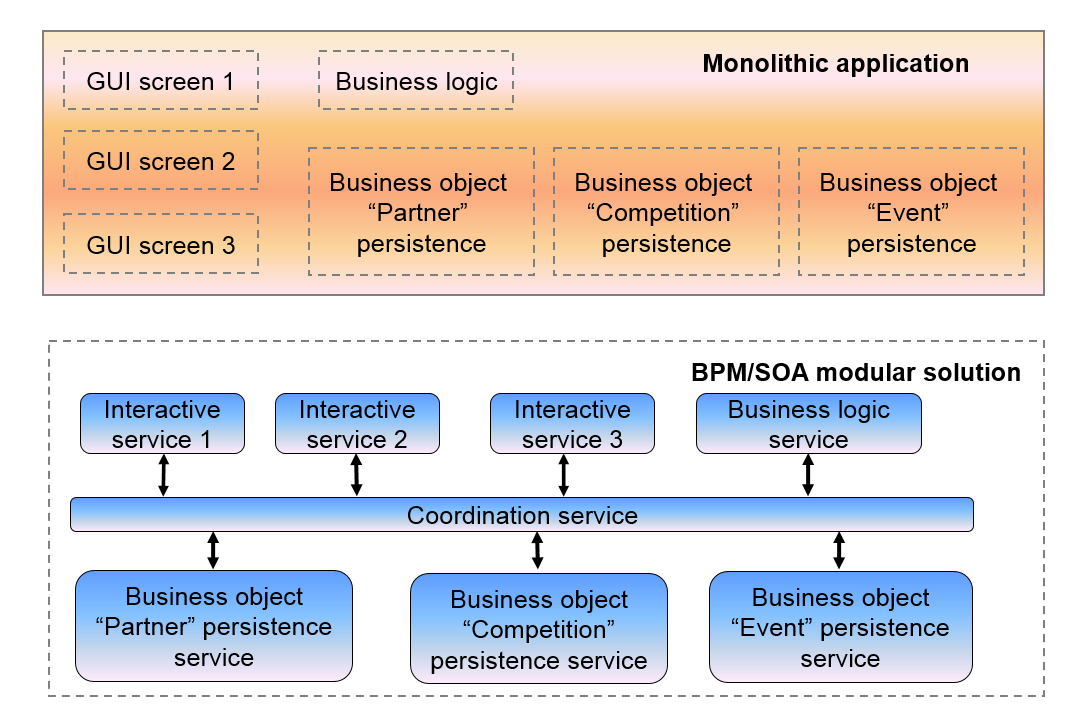
It seems that “application” (as a container of functionality) is too “big” and “smaller” containers of functionality are necessary. Thus services (as small containers of functionally) and processes (as a practice to assemble bigger services from smaller ones) should be used. In this case, shared services can be introduce as the following.


How to disassemble an application into services is described in http://improving-bpm-systems.blogspot.com/2014/04/ideas-for-bpmshift-delenda-est-vendor_27.html

Thanks,
AS

2014-04-27

Ideas for #BPMshift – Delenda est “vendor-centric #BPM” – How to modernise a legacy ERP

I was recently asked for advice on how to modernise a legacy ERP. It was developed long time ago to handle the core business. Right now it shows the following symptoms of difficult maintenance:
  • integration
  • incorporation of new technologies
  • old programming techniques
  • heavy releases
  • availability of industrial products for previously unique functionality (e.g. event management)
  • some generic functionality is commodity
  • just slow to evolve
Sure that the root cause is that the ERP had emergent/historical grow not being architected for such evolution.

The goal of modernisation can be formulated as the following:
  1. Agile (with the pace of business) provisioning of business solutions
  2. From disparate IT applications to a business execution platform which will “liberate” people for business innovations
  3. Combine various provisioning methods: assemble, rent, buy, build, outsource, centralised vs. kept locally, standardised, re-engineered or automated
The principles of the modernisation are defined in the following way:
  • Step-by-step technical transformation in two interrelated and intermixed streams:
    1. Disassemble ERP functionality into services
    2. Re-assemble business functionality via processes
  • Business evolution has to drive technical transformation (each transformational step brings something to business and does some modernisation)
Let us start from the simplest part - assemble via processes
  • A processes defines Who (roles) is doing What (business objects), When (coordination of activities), Why (business rules), How (business activities) and with Which Results (performance indicators)
  • Business processes make bigger services from smaller services


Disassemble an application into services schematically looks as the following:

Of course, disassemble of an ERP is more complex:


Advantages of this approach are the following:

  • Use of specific functionality from COTS (e.g. event management)
  • Use of generic functionality from “suites”
  • In-house developing ONLY specific-business-core-functionality
  • Integration of commodity or best-to-fit functionality
  • Faster evolution is possible because of BPM/SOA architecture

In case of transformation of a group of related legacy applications – please see http://improving-bpm-systems.blogspot.com/2013/06/enterprise-patterns-eclipse.html

Thanks,
AS

2014-04-16

Ideas for #BPMshift - Delenda est "vendor-centric #BPM" - enchancing the information #security

Enterprise functioning can be considered as business activity flows spanning the applications, employees, customers and partners within and beyond the boundaries of the enterprise. Staff as well as tangible and intangible resources are involved in each business activity. Ensuring of the information security implies the following characteristics of the enterprise functioning:
  • Any business activity is performed only as prescribed and any unintended use of information (e.g., access to information resources unrelated to the work performed) would be impossible in principle. 
  • Organization and initial planning of business activities must be validated for the compliance with the formal rules of information security. 
  • Execution and operational planning of business activities must be constantly validated for the compliance with the formal rules of information security. 
In this blogpost, it is show how BPM can contribute into enhancing the information security.


Control of access to an informational resource along the process


In simple cases, the control of access to an informational resource can be rigidly connected to the phases of the life cycle of the resource. The latter can be implemented as a business process. Explicit and executable business process is convenient because the whole dynamic of control access is embedded in the process.


This allows better control of access rights change.

Control of access to an informational resource within an activity


In more complex cases, information resources linked to specific business activities. An employee, appointed for the carrying out of a particular business activity, gets access to the information resources required for the carrying out this business activity, only for the duration of this business activity.


Objective operational data collected, who has/had access to what information resources will increase the level of information security.


Separation of duty within a business process


In a simple form, the separation of duty is a check that the actual work to be done (“Do” in diagram below) and the validation of the result of this work (“Check” in diagram below) are always carried out by separate staff members.


Thus, business processes can detect potential cases for the separation of duty by establishing relationships between business activities.


Separation and imposition of duty among several business processes


In a general form, relationships between business activities should be established and formally registered. A non-inclusive list of such relationships is the following: 
  • Other activities which validate the results of the given activity.
  • Other activities which define the governance for the given activity.
  • Other activities which do the handling exceptional situations for the given activity (error handling, escalations, send for review and delegate).
  • Other activities which audit the given activity (1st, 2nd and 3rd party audit).
  • Other activities which evaluate the risks before the given activity.
  • Other activities which evaluate the risks after the given activity.
  • Other activities which certify the given activity (1st, 2nd and 3rd party certification).
  • Other activities which do compensation (undo) for the given activity.

These relationships between activities define some limitations that roles and actors may carry out what activities: the same actor or a different actor from a different role or a different actor from the same role. For example, if the “Activity_B” validates the results of “Activity_A” then no actor should be in “Role_1” and “Role_2” simultaneously.


Thus, the separation of duty maybe formally validated at the design-time.


Management of risk along business processes


Managing any work by processes is the key business capability with allows to address the risk-related issues in a proactive manner. The risk is strongly related to how the business processes are carried out. By understanding a process (i.e. through being able to simulate it) the business may predict how the risk is changing during the execution of that process. The explicit description of processes permits to add a few “check-points” within any process to examine its risk-related “health”.

Business processes act as a skeleton to which the enterprise adds risk management (as shown on the picture below) – each usual activity is enriched by risk-related monitoring and evaluation.


The risk evaluation may initiate some risk mitigation processes. The risk evaluation may be as complex as necessary, and it may include simulations (e.g. value at risk and stress testing), and the conduct of statistical and scenario analysis.


Delenda est "vendor-centric BPM"
AS

2014-04-15

Ideas for #BPMshift - Delenda est "vendor-centric #BPM" - case for fusion of bank's front- and back-offices

The recent quotes digest in http://www.bpm.com/Blogs/bpm-quotes-of-the-week-april-11.html starts with my text "“Business is no longer a front and back office – all of your enterprise is the front office. Classic ad-hoc/dynamic processes and classic static processes will co-exist in the same BPM execution environment.”

This quote is based on the real story. It is usually not a problem for bridging front-office processes and back-office processes in their HAPPY PATH (see http://improving-bpm-systems.blogspot.ch/2014/03/enterprise-as-system-of-processes.html ).  It is much more difficult to bridge them in their ERROR-RECOVERY PATH. 

The story details.
  1. A client has a standing order defined in an e-banking system (front-office). 
  2. The e-banking system passes the payment to the bank's back-office system on each 25th of month.
  3. Once, the transaction initiated by the back-office it was rejected by the recipient's bank
  4. The back-office (which is based on a good BPM suite) starts its recovery-error process.
  5. That error-recovery process got struck in the back-office and the client didn't know about the failed transaction although money were debited from the client's account.
  6. The recipient has complained to the client.
  7. The client replied to the recipient that the e-banking shows that the order has been processed.
  8. The recipient has complained again.
  9. The client submitted an inquiry via the e-banking system.
  10. Somebody has replied that the back-office can't process the order for some reasons.
  11. The client called the front-office contact person - conseiller.
  12. The latter did some magic, requested to repeat this transaction again and confirmed that the money will be refunded in a few days.
The total elapsed time for this saga was 20 days. This means that during 20 days the client's money were lost BETWEEN the front-office and the back-office of a world-wide bank. Just wander what adjustment of internal business processes was made in this bank to avoid similar cases.

This bank is using a BPM suite for its back-office; There is no information about the implementation of its e-banking system. Ideally, the latter should be also process-based. But, as there is a huge fragmentation of the vendor-centric BPM market, modern BPM tools create "islands of BPMing". 

Thus the BPM industry must moving from vendor-centric BPM to customer-centric BPM.

Delenda est "vendor-centric #BPM",
AS


2014-04-09

Ideas for #BPMshift - Delenda est "vendor-centric #BPM"

From http://blogs.gartner.com/elise-olding/2014/04/02/introducing-bpmshift-bpm-is-dead-long-live-big-change/ and http://www.linkedin.com/groupItem?view=&gid=1847467&type=member&item=5857498506226319361 and http://bpm.com/my-bpm/forums/is-a-big-change-ahead-for-bpm

“At Gartner we believe that BPM practices as we know them won’t cut it in the future.”

Agree, the current BPM practices are non sustainable - BPM is often the reinventing the wheel in each enterprise, in each process and in each BPM tool. I think that the root-cause is the vendor-centric nature of the current BPM.

As any normal industry, the BPM industry must have 
  1. commonly-agreed BPM terminology, 
  2. a BPM reference model (for example, http://improving-bpm-systems.blogspot.ch/2010/02/bpm-reference-model-fragment-01.html ), 
  3. BPM reference architecture, 
  4. process patterns (for example,http://improving-bpm-systems.blogspot.ch/search/label/practical%20process%20patterns ) and 
  5. view that enterprise is a system of processes (for example, http://improving-bpm-systems.blogspot.ch/2014/03/enterprise-as-system-of-processes.html).

Ideal BPM practices should be able:

With the ideal BPM practices, the Elise’s list can be addressed in the following way:
  • is no longer a front and back office – all of your enterprise is the front office ==> classic ad-hoc/dynamic processes and classic static processes will co-exist in the same BPM execution environment.
  • employee is customer facing ==> a task for a customer may happen at any point in a process (and all exchange between an employee and a customer will be traceable).
  • will fall to the wayside – emerging organizational structures like holocracy will replace traditional org structures ==> process template will define the optimal org structure to execute the processes
  • view of end-to-end processes will be obliterated – order to cash will not exist ==> system of processes will may have more complex topologies
  • analysis will replace process analysis ==> process template and data collected from process instances will be used to analyse the behaviour of enterprises and customers
Delenda est vendor-centric BPM,
AS